
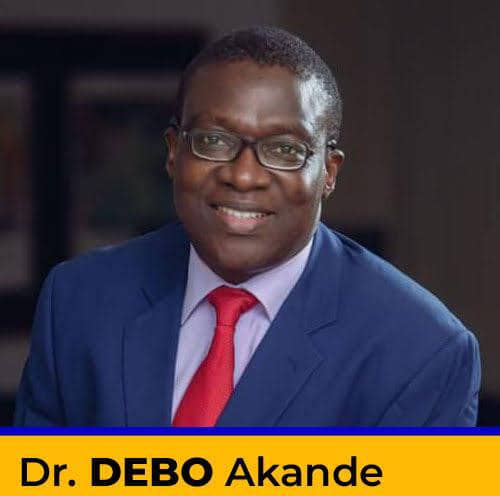
2027: Oyo Residents Will Decide Who is Right for Governorship – Debo Akande, Praises Makinde

Dr. Debo Akande, the Executive Adviser to the governor of Oyo State, Engineer Seyi Makinde, on International Cooperation and the Director General of the Oyo State Agribusiness Development Agency (OYSADA)
Dr. Debo Akande is the Executive Adviser to the governor of Oyo State, Engineer Seyi Makinde, and the Director General of the Oyo State Agribusiness Development Agency (OYSADA). In this interview with YINKA OLADOYINBO and BUSOLA OWORU of Nigerian Tribune, he speaks on the state’s exploits on the Agribusiness front, declaring that the management of agribusiness must be data-driven in order to attain the level of Nigeria’s peers like Indonesia and Brazil. Excerpts:

What was the state of agribusiness when you came on board in 2019, and how far have you been able to go six years down the line?
I am one of the first four or five people that were appointed in the government, at least in 2019, even before we had any commissioners. One of the reasons the governor made the appointment was to quickly ensure that we start putting our feet on the ground as it relates to issues from agriculture and agribusiness. His Excellency had envisioned agribusiness as a critical area for developing the economy of the state. You have other social, environmental, but if the economy is not doing well, where will you get the resources to also do all that? We commenced in 2019 by having what we refer to as an international stakeholders’ meeting. A lot of people always look at the hard infrastructure in development. We don’t tend to look at the soft infrastructure that supports the hard infrastructures and that help build it. To me, those are always very critical. System, process, strategy, they’re critical. If you build on nothing, you will just be doing things haphazardly. So from 2019, things were not done haphazardly, they were based on a strategy document that was developed in 2019 by internal stakeholders in the state. What do I mean by international stakeholders? We all sat down in Republic of Benin, Ministry of Justice, Ministry of Land, Ministry of Work, Education, Health, and so on. We chose from everywhere and we were all in Republic of Benin to sit down to extract where we were on agriculture and where we want to go to. So talking about where we were, we didn’t meet any strategy documents. That was a pointer to how the direction of agricultural and agribusiness should go, and that was a great reflection of our discussion during the stakeholders meeting.
The reason why we chose Republic of Benin then was because we were told about a particular facility in Republic of Benin, Songhai. So we wanted to see that Songhai place. One of the speakers was the then permanent secretary of the Ministry of Agriculture and Rural Development, and in his speech he mentioned the fact that Oyo State probably was the third or the second largest cassava-producing state in Nigeria, and the governor, who was present in the audience was asking questions like everybody, and his Excellency raised his hand and asked all these data that you gave to us, you’ve been the permanent secretary of this Ministry of Agriculture, were they gotten through accidentally or deliberately? The PS however answered that they were just accidentally.
The governor said you are very lucky. That because the next thing that I’m going to ask you is that you should give me the documents that you have used as a strategy, okay, and the process of deliberate action that has led to this. There and then, he made the statement that never in the history of the state, as far as he’s leading, will anything be done accidentally, he said the state will be led by science, logic, and data. That whatever we want to do now will be backed up with science, logic, and data, and that’s how it’s been. We met a state where agricultural budget was almost nothing. So we become empirical. I mean, we’ve been playing lip service about agriculture.
So for the three days spent in Republic of Benin what were those things you discovered and came up with?
Generally in Africa, for a very long time, we have been playing lip service to agriculture. We say one thing, we do another thing. CADAP, African Union CADAP, advised us as countries that any nation that would do well on agriculture will have to use at least 10 percent of its budget. Expend it, not just allocate it. That’s when you see impact. The only country, or one of the few countries that are doing well on agriculture today, Ethiopia inclusive, go and check their budget, that’s exactly what happened. Even in Nigeria today, I don’t think we are doing more than 2 to 3 percent. So by then, the total percentage of our agricultural budget to the state budget was not more than 2 to 3 percent. So one of the first things we noted was that. The second thing was that it’s not just about the budget. It’s even about where the budget channels towards. So majority of the budget plus over 80 percent of those budgets were just primarily channels towards input distributions. You’re talking about agriculture that will build the economy. What we were focusing on was just input distribution, and I will tell you the implication of that. That’s a part of the thing that we came up with during that state budget summit as well. You cannot say that you will have agricultural transformation without rural infrastructural transformation. Here we are for a very long time, all what you are doing was to use 80 per cent of your fund on just input distribution alone. No further fund that is going into the rural infrastructural development and diverse other areas of agriculture as well. So those were the things that we met on ground.
The budget was infinitesimal. If you can use that, it’s not something that is anything to write home about. Aside that, the area where the budget is also channeled to was not adequate enough to build agricultural sector of a state. In a manner where it should build, it should develop an economy. The third thing that I also want to mention is that, if you know very well, and across Nigeria, most of the states, you will hear Ministry of Agriculture and Rural development.
Did you see anything rural development in agriculture? No. So the Agricultural has been swallowed up by rural development. They were not doing rural development. It was just the agricultural aspect. But we called it Ministry of Agriculture and Rural Development. Check across the whole of Nigeria, there’s only a few states that you will see that truly they are engaging in rural development. Those that designed those ministries as Ministry of Agriculture and Rural Development, they know what they’re doing. They know that you cannot truly do agricultural transformation without rural transformation. So we also knew that. Those were part of the thing that helped to strengthen our thinking; we also noted that, before we came on board, the primary focus of agriculture was just on smallholder farmers.
There was nothing wrong in that, but the fact remains that, if you’re thinking about agriculture that will build your economy, economic growth, economic development, food sustenance, you have to do even that. Check Brazil, check many advanced countries. I like using Brazil and Indonesia as good examples because they have similar narrative like us, but they’ve moved ahead of us. How did they move away from where they were to where they are now? It’s one of the things that we have mentioned. They also moved away from just a smallholding-driven agricultural economy to an economy that has so many other actors. They didn’t neglect smallholder farmers. Don’t get me wrong, they created a system where the smallholder farmers moved from what is referred to as smallholder farmers in their own time today to what you can refer to as the medium to large farmer in their own time. What they refer to as smallholder farmers in Brazil today is what we are referring to as large farmer in our own country.
In terms of land size, in terms of the capital they have for the business, in terms of their output. In fact, those that we are referring to as smallholder farmers in our country today should be referred to as micro-farmers, not small, because the land size that they have been engaging on, on average, is between 0.7 to two hectares of land averagely. If we just want to work with smallholder farmers here, the land mass of Oyo State is 28,000 square kilometers and 70 percent of that land is arable, meaning that we can use it to plant crops, produce livestock, for agriculture .And to put it in context, this 28,000 square kilometres is almost exactly the same size as the whole of the southeast of Nigeria, states combined.
The whole of the southeast combined, state combined, is probably 29,000 square kilometres. So Oyo State is as big as the whole of the southeast of Nigeria. And if you are trying to look at countries in Africa, Oyo State is bigger than Rwanda. It’s bigger than Burundi. Belgium is just 2,000 square kilometres bigger than Oyo State. So this is one of the problems we are having across board, not just in Oyo State, across the whole of Nigeria and in Africa as well. It requires changing our narratives and learning from the kind of Brazil and Indonesia.
So how far has the document from the stakeholder meeting influenced the agricultural sector of the state?
We developed this document that is guiding us to ensure that, one, we don’t make the same mistake. The first thing is to see what we can do to complement what is on ground. And as we have agreed that it cannot just be a small holding system. We know that we need to bring in new set of actors into agriculture, in this instance, the private sector and also the younger people into the system. To also draw resources from international technical partners into the state. That led to the creation of a special purpose vehicle referred to as Oyo State Agribusiness Development Agency today, the agency is not meant to replace the Ministry of Agriculture and Rural Development, as some people misconstrued at the point in time.
It is meant to complement what already existed. The then OYSADA was defunct, but the Department of Extension Services was created in the Ministry of Agriculture and Rural Development. All those extension people were moved there. Because people also said there are no extension services anymore. But that wasn’t true. A directorate was created and they moved on that. And the OYSADA, as we know it now, I happened to be the first pioneer DG, aside my role as advisor to the Excellency, then started doing what he needs to do, to draw his plan on how best he can bring in investment in agriculture into the state at the medium to large, and also what could be the constraints from bringing that. Again, we all agreed that if we are going to bring investors to the state, you need to create an enabling environment for them and ease of entry. One of our first points of agreement on ease of entry is to create that hub, one of which we built at Fashola. If you create an ease of entry, where private companies will not need to buy land, will not need to pay Omo onile, will not be looking for road infrastructure, will not be looking for energy, will not be looking for security. It’s easier for them to just plug and play. So that was what led to the development of that Agribusiness Transformation Centre at Fashola, and we now have industries there. We’ve demonstrated what they call the proof of concept in that place. We have production sites there. If you go there now, you will see one company cultivating nothing less than 300 hectares of maize. When we went there with some high-level people in the state, it was a drone that we were using to look at this farm for cultivation. But is that all what we should do? No. That is to demonstrate what is possible and what is replicable across the whole of the state. And that is what is leading to what we are doing in Ijaiye now, and what we are also doing in Eruwa. Ijaiye is going to be like four times the size of Fashola. Eruwa is going to be almost the same size as Fashola.
What are the deliberate policies and initiatives that were put in place to promote agribusiness and to strengthen agribusiness in this state and what has been the result and benefits?
The rural infrastructure development that I mentioned before is a deliberate policy of the government that in the first term of his Excellency we will focus towards the development of rural infrastructure to open up our agrarian area. One of the major problems you will find with agriculture that I have mentioned is that the rural problem is a case of when you can’t move your product off the farm. You produce and you can’t move it, this is very common. It is known in literature and generally that over 40 percent of what we produce perishes on the farm. What we call a post-harvest loss. So now, I challenged and I said just go on some of these roads that have been built in the rural area, station there for two hours, if you don’t count up to 20 pickup vans that will be carrying food stuff. I’m talking about Iseyin/Fashola/Moniya, Ijaiye Iseyin, Fapoto, Ogbomosho roads. In just one hour, you will see 20 pickups picking food; I’m talking about cassava, maize.
We have data of how much of our product is moving out of the state. So that’s one of the deliberate policies to look at how to open up rural areas to ensure that we reduce the level of post harvest loss. But it’s not even just those roads alone that we are doing, we also have now the World Bank projects on Rural Access and Mobility Project. That gives us the opportunity to do 1,200 kilometres of rural roads, of feeder roads. So on this road that has been done, the feeder roads on it that is going into the farm now. We have 1,200 kilometres of road to be done. We’ve commenced with 100 kilometres. This will continue and you can imagine what that means once you go into the farm.
When Chief Obafemi Awolowo established some of these farm settlements in western region, we were told they were established to help small scale farmers, but the way you are implementing these projects now, don’t you think that idea has been defeated?
The question that we should ask is since the time of Baba Awolowo set up these farm settlements, what has happened till now? What happened to the productivity after their own era? I meant that is not to cast aspersions on them, some are doing well but they are not optimally used. They were not properly used, I will say that what we are doing is no longer a farm settlement, what we are doing is what we refer to in Agribusiness as industrial hubs and they are not necessarily displacing the farm settlements, if I can use that word. There was no farm settlement in Fashola when we started, Fashola is not a farm settlement, it was only a portion of the land in IJAIYE that was being used and it was not a farm settlement, because IJAIYE when we went there was a degraded forest and then farm settlement happens to be part of it. So farm settlement is still there, it is not taken away; I think it is the misconception of some people.
Eruwa is actually a farm settlement in itself, what we’ve done, is the enumeration, they even agreed with us that it was not optimally used. We relocated them into a place where there will be cluster, in the right sense of it. That is in Eruwa where we know that they are farming there but one will be here and then another one will be in that place and then you will have bush in the middle, they are not even enjoying maximally what they should enjoy because they are not clustered in one place. Ideally like 50 of them should be in one location, they have two, two plots or three, three plots, and then it’s easy to support, so that will be happening in Eruwa but all the places that we are using as farm settlements, will become useful.
One company in Fashola alone has over 3000 farmers that are supplying them with cassavas, in fact they have them registered under them, they support them, I went there and I met them, in fact they don’t even need to meet me any longer. Can you imagine if I have 100 of that company, how many farmers i will be supporting without one naira of the government, and can you imagine how easy it is for me if I want to implement a support program in the state, to go to all these company to ask “who are the farmers under you”? This is my support to them, it becomes easier and targeted and direct, something that is more impactful. Saltry farms alone has over 6000 farmers, Lichy farms in Ilero is doing wonders, the sugar factory said it is working with over 3000 farmers and developing a scheme around the farmers to grow sugar for them. These companies are coming to complement and also support the lives of the farmers to be better; I am envisioning seeing more than 200 of these companies coming. Another deliberate policy of government is the establishment of OYSADA which has made it easier for these companies to come in. Now they have somebody to talk to instead of moving from one ministry to another, OYSADA is a one stop shop.
What specific role has OYSADA played in the revival of agric practice in this state and what has been its impact in the productivity of the farmers?
OYASADA mandate is focus on moving agriculture from medium to large and also the youth in agriculture and to collaborate with international technical partners to help strengthen the downstream of our agriculture. In agriculture, there is the upstream and the downstream but in agriculture we focus just on the upstream, that is the production area but what about the processing, what about that area where they said that we have lost our economy? Where we only export prosperity and we import poverty, I think the poverty area of agriculture is the processing side and that is what OYSADA has come to do for Oyo state and has done. All these industries we are talking about have come to this state as a result of OYSADA, OYSADA is the one that developed the strategy that Oyo state government is using today, OYSADA is the one that built Fashola, OYSADA is the one that brought the majority of the investment in agriculture to Oyo state today, OYSADA is the one that brought all the technical partners to Oyo state, OYSADA brought all the international development projects that you see in agriculture today, OYSADA is the one that has ensured that investment are driven into agriculture today, OYSADA is the one that connected all these investments with the small holder farmers in the state, OYSADA is the one that solved the scientific aspect of agriculture that I mentioned earlier, so there’s quite a lot that it has done. If you look at agriculture today at least I can tell you that OYSADA has brought nothing less over 100 million dollars to Oyo state in terms of finance for projects and investment. I can give you the total number of investments that is in Fashola that day, it is almost four times what the state government spent to build the place. OYSADA is the one that is working on building further hub that is in Ijaiye that is going to close to 30 industries.
OYSADA was established in 2022, so we are talking of an investment that was just established 3 years ago.
You hope that somebody that keys into the vision of his Excellency comes after him. I want to ask, are you aware that people have rumored that you are the favored one that you will take over from Governor Makinde?
I have also heard , the way you heard, is the way I also heard, you know and one of my friends called me and said “ Debo I heard” but I told the people that told me that you have not told me that you are interested, if you are interested by now, I would have known. I think it’s natural for people to speculate, I agree that I am very close to his Excellency, it’s just natural, he’s just like a brother to me, I adopted him as a brother and it goes beyond political system, and of course in life, I learn from people and he’s my mentor and he’s my boss. I ask him questions a lot. I have been very privileged to be one of the few that have traveled with him the most and to draw resources to the state, people have seen us together and doing quite a lot for the state and again, maybe because agribusiness has become one of his hallmarks so it is natural for people to say this. His Excellency has mentioned that we are building it and I think that is very important to say, it’s going to be a team work and one person will lead the team and it could be anybody, but the prayer for us is that it should be the person that has the capacity that could lead the rest of the team and lead us well and have the empathy of the people and can deliver
I also, have said on several occasions that anybody that is going to enter that shoes of his Excellency should think twice, anybody that doesn’t want to destroy the name of his father should think twice before entering Governor Makinde’s shoe, this man has delivered, he has done so much for the state, so if you don’t have the capacity don’t even bother yourself, I am also from Ibadan, Oyo state, I know his work ethics, this is a man that you need to be ready for work to work with him, I have worked with him and I’ve known that it is not an easy thing to do. It is not a tea party, it is something that requires a lot of dedication, extra effort, late night work, brilliant ideas, you must be able to manage human beings, flexibility and high level of engagement. It requires a lot, not just I want to be a Governor.
So, he may recommend, it is left for the state to know whether the person is right or wrong and then we are hoping that God will grant him the grace to choose right.
In your own opinion, do you think you are ready?
I think the Oyo state people should judge whether I’m ready or not or if I’m prepared for that or not. They should judge, but the fact remains that you are also part of the stakeholders and you should also state whether this man is ready or not or if this man has the capacity for that or not. So I think I will leave that to the leadership of the state and I will leave that to my boss and mentor as well to conclude, I will leave that to the people of the state to make a conclusion as to whoever has that capacity to lead and I believe that will be the right thing to do.
Nigerian Tribune
