


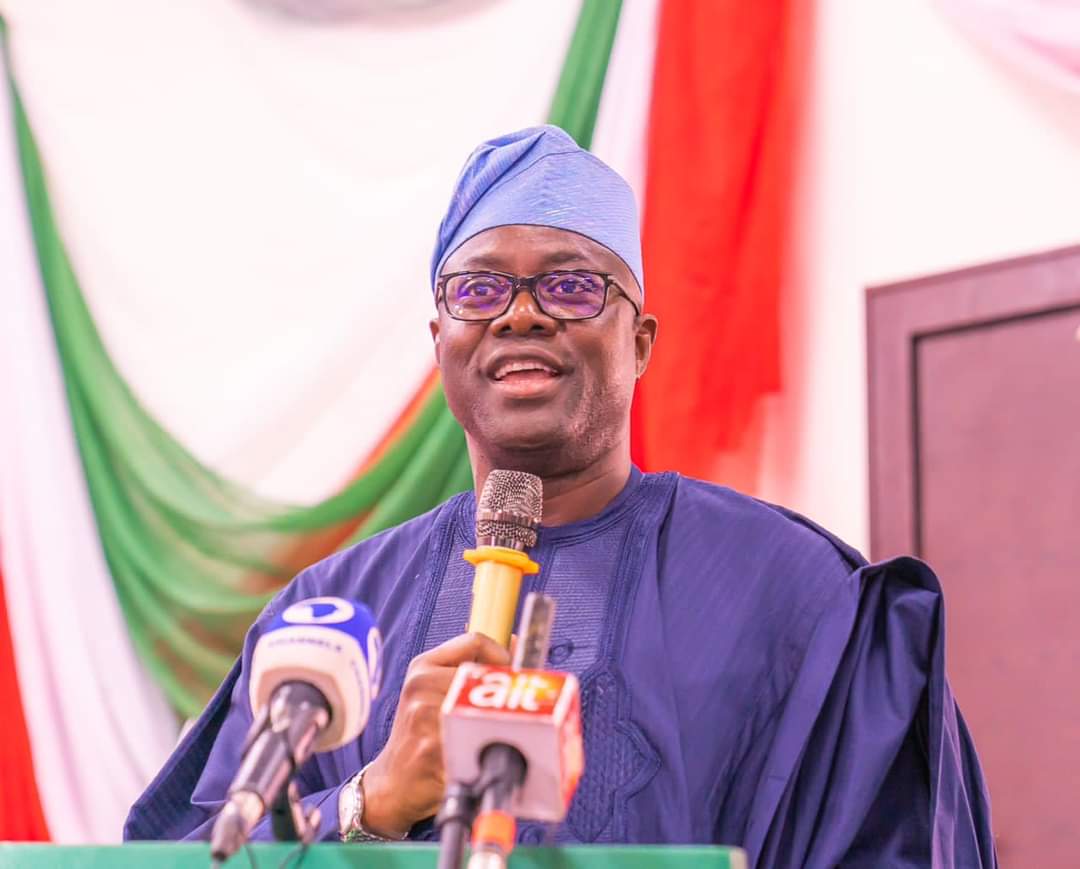
Oyo State Governor, ‘Seyi Makinde, has emphasized that the decision regarding his successor lies firmly with the people of Oyo State. In his bi-monthly newsletter, the governor reflected on his administration’s achievements, noting that it has redefined governance through strategic planning and purposeful execution, demonstrating to residents what is attainable. However, he acknowledged growing public curiosity about the future and concerns over whether the next governor might undo the progress made.

This statement was part of a press release signed by Dr. Sulaimon Olanrewaju, Special Adviser (Media) to the Oyo State Governor, on March 8, 2025.


Governor Makinde assured residents that they hold the power to shape the state’s future by selecting his successor. He added that, in due course, he would disclose his preferred candidate for the governorship to ensure Oyo State remains on its current path of sustainable development and transformation.


With over two years remaining in his tenure, Makinde urged the people of Oyo State to anticipate further advancements in key sectors such as infrastructure, tourism, agribusiness, and solid minerals development, all aimed at bolstering the state’s economy. Citing the recent visit of Dr. Julius Maada Bio, President of Sierra Leone, to the Fasola Agribusiness Industrial Hub, the governor highlighted the international acclaim Oyo State has earned for its agricultural initiatives. He noted that President Bio was so impressed by the state’s agribusiness policies that he extended an invitation for further collaboration in Sierra Leone.

Makinde attributed the state’s agricultural success to a data-driven, science-based approach, which has yielded significant results. He referenced the tractorisation policy as an example, admitting that its implementation reached only 5 percent in 2024. To address this, the administration plans to eliminate bureaucratic obstacles and enhance communication to better engage farmers. The policy, designed to subsidize ploughing costs by 50 percent, targets 120,000 hectares of farmland to boost agricultural productivity.
Reflecting on recent developments, Makinde remarked, “It has been an exciting week for us in Oyo State. The international community has recognized our efforts in agriculture, though I must clarify that when we began this journey over five years ago, our goal was not accolades. It was driven by data, science, and logic, positioning agribusiness as a cornerstone for lifting our people from poverty to prosperity.”
He explained that the state has adopted an unconventional yet strategic approach, collaborating with the private sector to support smallholder farmers rather than purchasing government-owned tractors that might prove difficult to maintain. “We’ve tested what works and what doesn’t,” he said. “Our recent 5 percent success rate in tractorisation has taught us valuable lessons. Moving forward, we’ll focus on better communication and removing obstacles to ensure farmers fully benefit.”
Makinde also addressed the Fasola project, which, despite not meeting its ambitious one-year completion target, has garnered international praise. “We’ve learned from this pilot and are applying those lessons as we expand to Eruwa and Ijaiye,” he noted.
Amid questions about the administration’s remaining two years and the continuity of its initiatives, Makinde reiterated that the future rests with Oyo State’s residents. “You entrusted me with the opportunity to serve, and it will be your decision to choose who comes next,” he said. He recalled his remarks at the 11th Omituntun Ramadan Lecture, where he promised to announce his preferred candidate for the 2027 gubernatorial election in 2026. “Ultimately, it will be up to the good people of Oyo State to decide if they want continuity,” he concluded.
