


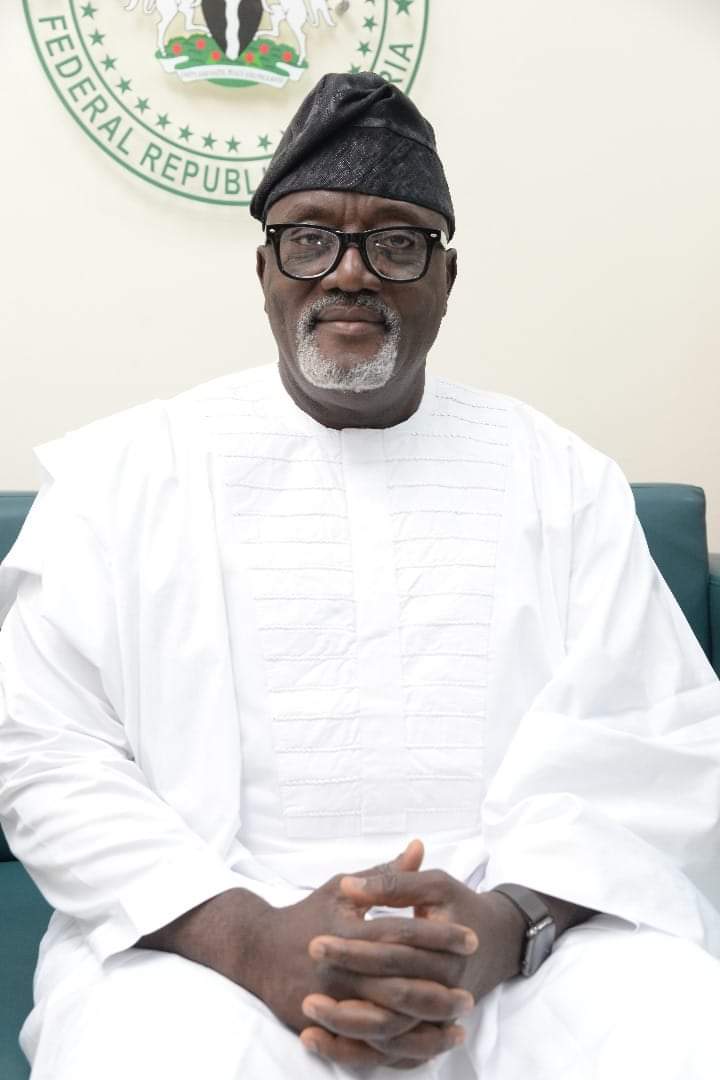
By Oyo Amebo


What does one call a leader who does not arrive with fanfare, yet somehow commands attention without raising his voice? How does a public servant become a quiet force in a political landscape that rewards noise?


And what happens when a man builds influence not through boasting, but through an almost disarming devotion to the people he serves?


These questions linger like an echo around the figure known simply as Odidiomo, Honourable Adedeji Dhikrullahi Stanley Olajide, a man whose political journey seems to defy the predictable script of Nigerian public life.

At first glance, he appears almost ordinary: no theatrical speeches, no dramatic confrontations, no entourage announcing his every movement.


Yet the more one listens, the more one realises that there is something quietly extraordinary about him, something that makes his rise not just remarkable, but almost inevitable.



For his story does not begin where most political ambitions are born. There were no elite gatherings, no whispered alliances, no strategic posturing.

Instead, his path winds through the familiar sights and sounds of Ibadan: the crowded stalls of Dugbe, where traders argue over prices; the dusty workshops of Apata, where apprentices hammer their way toward a livelihood; the bustling schoolyards of Omi Adio, where children chase futures still taking shape.
These everyday scenes were his first classrooms, and the people who lived within them were his earliest teachers.
Long before he occupied a seat in the National Assembly, Odidiomo was already stepping into roles that had no titles, problem-solver, advocate, organiser. When clinics faltered, he was there. When schools struggled, he appeared.
When neighbourhoods felt vulnerable, he stayed until solutions were found. These were not calculated gestures, but grounded responsibilities he embraced without ceremony.
So when he eventually entered federal politics, the transition seemed less like an ascent and more like a continuation of work already in progress. His contributions in Abuja have reflected this rootedness.
Motions, bills, debates – none have been designed for applause; all have been crafted from the real, breathing concerns of his constituency.
Not imagined problems, but lived ones: unemployment, weak educational structures, neglected local industries. His legislative imprint is simply the voice of his people translated into policy.
Yet what surprises many is not just what he does, but how he does it.
At his town-hall meetings, one expects the usual choreography of political performance. Instead, one finds something almost unsettling in its honesty: residents asking sharp, uncomfortable questions; Odidiomo answering them without deflection; budgets examined openly; timelines dissected; criticisms acknowledged. In a system where opacity often reigns, his brand of transparency feels almost rebellious.
And then there is his approach to empowerment – not the type designed for cameras, but the kind that shifts lives in quiet, steady steps. Scholarships that expand options.
Skill programmes that transform job seekers into employable professionals. Grants backed by mentorship, ensuring small businesses grow rather than collapse under the weight of inexperience. It is empowerment by design, not by chance.
Walk through his constituency and the evidence is almost impossible to ignore: roads once abandoned now easing daily movement; schools once forgotten now stirring with activity; healthcare centres revived from decline. These changes do not shout; they simply speak for themselves.
Yet the most intriguing part of Odidiomo’s story may be what he chooses not to pursue. In a political arena obsessed with the next office, he refuses to hint at the future.
No declarations, no ambitions disguised as “calls to serve,” no strategic whispers. Just a steady insistence on doing today’s work well.
It leaves observers wondering: is this reluctance a strategy, or genuine restraint? A mystery, perhaps deliberately woven into his leadership.
What is clear, however, is that Odidiomo is rewriting the script of political relevance in Ibadan. He is proving that power does not always announce itself. Sometimes it arrives quietly, through actions that ripple outward until a community begins to feel the difference.
He stands as a reminder that in an age of noise, there is still room, and perhaps growing hunger, for leaders whose strength lies in listening, whose influence grows from trust, and whose legacy will be defined not by slogans but by the simple, profound discipline of showing up where it matters.
In Odidiomo, one finds not just a politician, but a lingering question: if more leaders followed this path, how different might Nigeria’s political story be?
