
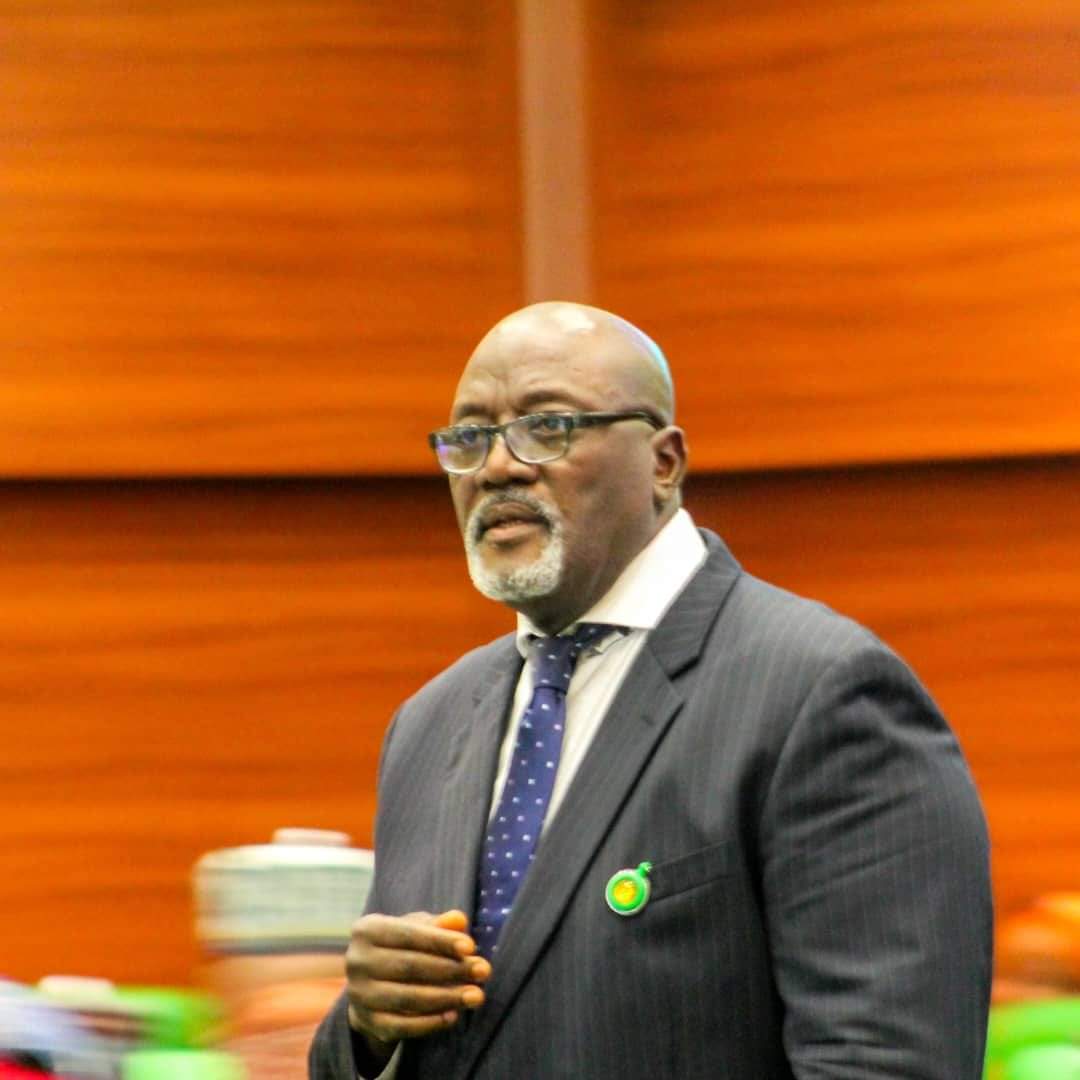
Quiet Evidence, Visible Result: How Odidiomo Became Oyo’s Unannounced Political Reference Point

By Oyo Amebo
Political relevance is often carefully engineered. It is proclaimed through rallies, amplified by slogans and sustained by relentless visibility. Yet, on rare occasions, attention forms differently, earned rather than demanded, guided rather than choreographed. Oyo State appears to be experiencing such a moment.

As 2027 draws nearer, Honourable Adedeji Dhikrullahi Stanley Olajide, popularly known as Odidiomo, emerged as an unexpected centre of political discourse.

Not because he has declared an intention, signalled an ambition or mounted a campaign, but because conversations about him continue to surface, persistently and organically.
Across community gatherings, professional circles and quiet political assessments, his name appears not as idle speculation, but as a considered possibility. It is a form of relevance that does not rely on anticipation alone, but on accumulated experience.
This attention is not the product of mystique or calculated silence. It is rooted in proof. Over time, Odidiomo’s record in public service has revealed a consistent pattern that resonates deeply in a political climate weary of promises.
His approach has followed a clear and disciplined sequence: identify genuine needs, intervene with precision, and remain accountable for outcomes.
In an environment where many public figures are evaluated by declared intentions rather than delivered results, such a sequence stands apart.
Leadership, after all, is not a performance to be staged; it is a practice to be sustained. In contemporary politics, the distance between the two has rarely been more pronounced.
Public confidence has been steadily eroded by excessive rhetoric, premature ambition and governance that arrives wrapped in explanation rather than evidence. Against this backdrop, Odidiomo’s restraint does not read as hesitation. Instead, it conveys clarity.
Throughout the last political cycle, he resisted the temptation to signal upward ambition. There were no rehearsed claims of readiness, no media-driven positioning, no symbolic gestures designed to test the waters.
Rather, he remained anchored in the discipline of service, engaging directly with his constituency, responding to tangible social needs, and returning consistently to assess outcomes.
Ironically, this absence of spectacle has intensified scrutiny of substance.
At the grassroots level, this distinction is even more evident. Community engagements are not treated as endorsements waiting to happen, but as platforms of accountability. Progress is measured, not assumed. Shortcomings are acknowledged, not obscured. Feedback is received and applied.
In doing so, a rare balance has been cultivated: familiarity without complacency, accessibility without populism.There is also a discernible evolution in how political stakeholders now speak about him.
The discourse has shifted from curiosity to calibration. Analysts increasingly consider whether a leader shaped by evidence rather than emotion can navigate the broader complexities of governance.
Can political authority be built primarily on credibility? Can trust, accumulated patiently over time, rival—and even outperform, the traditional machinery of mobilisation?
By the end of 2025, Odidiomo’s name had come to signify more than an individual. It had become a question, one repeatedly posed by a public exhausted by political excess. What if leadership did not begin with ambition, but with assurance? What if governance demonstrated capacity before seeking expansion?
Whether he ultimately chooses to pursue a larger mandate remains undecided. Yet the political environment around him has already changed. When a public figure becomes relevant without self-announcement, when advocacy precedes ambition, the established rules of engagement begin to shift.
Oyo State, therefore, finds itself at a subtle but significant threshold. Not between personalities, but between political cultures. One that celebrates declaration, and another that responds to demonstration. The growing attention around Odidiomo suggests that many observers are quietly gravitating towards the latter.
The remaining question is no longer whether leadership can emerge without noise, that answer appears increasingly settled, but whether Oyo is prepared to fully embrace a politics grounded in proof rather than proclamation.
