


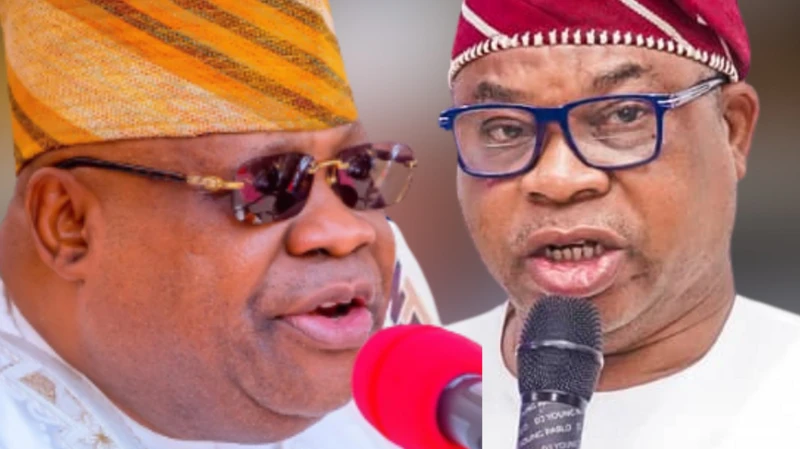
The Osun State governorship election may have been won and lost, yet the echoes of that off-cycle contest will continue to reverberate well into next year’s general elections, scheduled for 16 January and 6 February 2027.
Since the Independent National Electoral Commission (INEC) announced the results of the 15 August governorship election in Osun State, which showed that Governor Ademola Adeleke of Accord had won with 511,067 votes, defeating Bola Oyebamiji of the All Progressives Congress (APC), who polled 444,815 votes, the winning camp has celebrated exuberantly. The defeated party, meanwhile, has retreated to lick its wounds and count its losses. Some APC stakeholders have, in their analyses, laid the blame at the door of the former governor of the state, Gboyega Oyetola, whom they accuse of “exclusionary politics.” They have also called on President Bola Tinubu to probe the Minister of Blue Economy for his role in the party’s defeat in Osun. As the saying goes, there are always two sides to a coin. Oyetola will no doubt have his own explanations, yet it was plain that the groundswell of support was for Adeleke. Whatever excuses may be offered cannot alter the fact that the people of Osun rejected Oyetola’s brand of politics and every attempt to substitute the will of the majority for the wishes of a tiny minority.

Yes, Governor Ademola Adeleke, the Adeleke family, members of Accord in Osun State, residents and indigenes of the state, and democrats across Nigeria have rejoiced over the victory of the Imole Osun, as Adeleke is fondly known. It was a victory well worth celebrating, especially for true democrats. One question, however, remains: was the election free, fair and credible?



INEC and the five-hour question
Before answering the question above, I feel compelled to raise concerns about the conduct of INEC in the Osun election. The commission’s performance on 15 August helped me understand the frustrations of those who still lament the electoral glitch it claimed to have suffered during the 2023 presidential election; its handling left a great deal to be desired. Musician David Adeleke, popularly known as Davido, was quick to draw the world’s attention, via social media, to the sudden halt in the publication of results on INEC’s iREV portal. I, too, was monitoring the platform, which had become the most reliable source of information that day. Those of us in newsrooms noted that between 5.30 p.m. and 8 p.m., 87 per cent of the polling units had been uploaded. The platform then froze, and no amount of refreshing could restore it. The figure remained stuck at 3,292 polling units uploaded out of 3,763. Newsrooms were left in limbo for more than five hours while 471 units remained outstanding. Although Governor Adeleke was leading the APC candidate at the time, no one could declare the outcome with certainty, mindful of the 2018 experience in which the nullification of just seven polling units rendered the election inconclusive. With no word from INEC and no further updates on the iREV portal, some editors waited longer while others simply went to bed at midnight.
That five-hour gap on the iREV portal is dangerous, and it is a trend that election observers must watch carefully as we approach the 2027 elections. How will the commission explain its ability to upload 87 per cent of the results across the state within three hours of the close of polls, yet was unable to upload the remaining 13 per cent for more than five hours thereafter? Was voting continuing in those units? Is it plausible that all 471 units, spread across the 30 local government areas, simultaneously experienced network difficulties? INEC’s conduct lent weight to Davido’s suggestion that one party was angling for an inconclusive election—something democrats must remain vigilant against. Elections should reflect the victory of the majority, not the imposition of a minority’s wishes. Until INEC produces a credible explanation for what ailed the iREV portal for five hours on Osun guber election day, candidates and election watchers must keep a close eye on Professor Joash Amupitan and his commission.
Was the election free and fair?
Now to the central question: was the Osun election free, fair and credible? Taking the last element first, yes—the election was credible because the true will of the people ultimately prevailed. The credibility of the result lay in the resolve of the people of Osun to ensure that their votes counted. It lay in their determination to resist harassment from official, semi-official, and unofficial quarters, to stand by the man they believed had shown flashes of good governance in recent years, and in their refusal to be swayed by the allure of vote-buying. When dozens of governors and other senior officials of the ruling party descended on Osun, one thing was clear: they had not come to visit the Osun-Osogbo grove or to partake in the Egungun festival, which is popular around this season. Unless we choose a different label, the only plausible reason so many officials would arrive in a state where they are not registered to vote is to intimidate the electorate with the “power” of high office. Whether one calls it vote-buying or something else, we all know that cash is easily moved in official convoys, beyond the reach of the men in red from the EFCC.
Yet the people of Osun resisted the temptation of ₦15,000, ₦20,000, ₦30,000 and even ₦50,000 per vote and stood by their choices. Credit is due to those who refused the loose money. I was also told that some collected the “free” cash and still voted against the wishes of the vote buyers. Osun has shown itself to be a state still largely populated by omoluabi. We commend that majority.
The last time I witnessed something comparable to this open defiance of vote-buying was in Ogun State in 1999. The Peoples Democratic Party (PDP) was projecting General Olusegun Obasanjo as its presidential candidate and sought a strong showing in the Ogun governorship election between Chief Olusegun Osoba of the Alliance for Democracy (AD) and Chief Jubril Martins-Kuye of the PDP. At that time, the people of Ogun composed a derisive song: “We have two Oluseguns, but one is afraid” (Olusegun di meji, eru nba ikan). I was present when PDP leaders distributed election logistics to local government co-ordinators on the eve of the poll. To the astonishment of the man who had handed out the materials the night before, some of those who collected them simply went about mobilising for Chief Osoba. He was shocked to encounter supposed co-ordinators on the streets during the election who sternly warned him to leave the field to them and to Osoba, declaring that the day belonged to the AD candidate. The man was left speechless and thereafter lost interest in politics. I was not surprised, later that evening, to sit with Chief Osoba while our conversation was repeatedly interrupted by calls from PDP turncoats relaying results from their units, wards and local governments to the man they had chosen to support. From the reports that emerged, something similar occurred in Osun on 15 August as Adeleke coasted to victory. The people did not merely cast their votes and go home; they stayed to defend those votes through the night.
Turning to the other part of the question, I say without hesitation that the election was not free and fair. The heavy security presence, the relentless arrests of Accord chieftains, the arrest of the Secretary to the State Government, Teslim Igbalaye, with two permanent voter cards and a copy of the voters’ register for his area, and especially the EFCC’s attempt to freeze the state government’s accounts were all clear signals of unfair treatment of the ordinary voter in Osun. In a sense, this also did the APC a disservice, for it became obvious that the people had been driven to the wall. For many in Osun it was a matter of survival. Adeleke represented a resurrection from the near-death experience of twelve years of APC rule. The state laboured under a crushing debt burden; salaries, pensions and gratuities went unpaid; and the concept of half-salaries became commonplace under the APC. For teachers, civil servants and all whose livelihoods depended on the welfare of those workers, the only rational choice was to stick with Adeleke, whose administration had restored hope by paying salaries, pensions and gratuities and by releasing funds due to the local governments that the previous administration had withheld. The people therefore faced one direction and defended their position stoutly.
It was evident that many of those who flock around seeking our votes are pseudo-democrats—men and women who would rather thwart the will of the majority to serve the whims of a minority. The clear intention was to scare people away from the polling units so that a handful of supporters could deliver the desired result. This was visible in the videos that circulated online: a woman vowing that anyone who voted for her opponent would not leave the venue alive; Senator Francis Fadahunsi, first caught ordering his people to “kill Accord”, which he recounted, then later heard telling supporters to check how voters in his unit marked their ballots and declaring that anyone who voted against his party must be a bastard. Such scenes cannot be described as free and fair. Going forward, particularly for off-cycle elections, the nation would do well to adopt the President Goodluck Jonathan approach. The former President said last week that the influx of governors and government officials into states holding elections is wrong. I agree with him, not least because he practised what he preached while in office. During the 2013 governorship election in Anambra and the 2014 contest in Ekiti, Jonathan’s government prevented governors from flooding those states, whether to support his own party or to hinder opponents. In Ekiti in 2014—an important electoral battleground for the then-emerging APC—reports indicated that, because the government had made it difficult to move money through banking channels to the APC candidate, the opposition planned to bring in cash via a contingent of governors. Jonathan’s administration cordoned off the state and turned the governors back at the borders. There was a notable confrontation with the then Governor of Rivers State, Rotimi Amaechi.
If our elections are to reflect the genuine wishes of the people, President Bola Tinubu must restrain his officials from flaunting the so-called federal might—a force they routinely overrate above the delivery of good governance. We all know that this “federal might” is often little more than a euphemism for vote-buying and electoral manipulation.
