
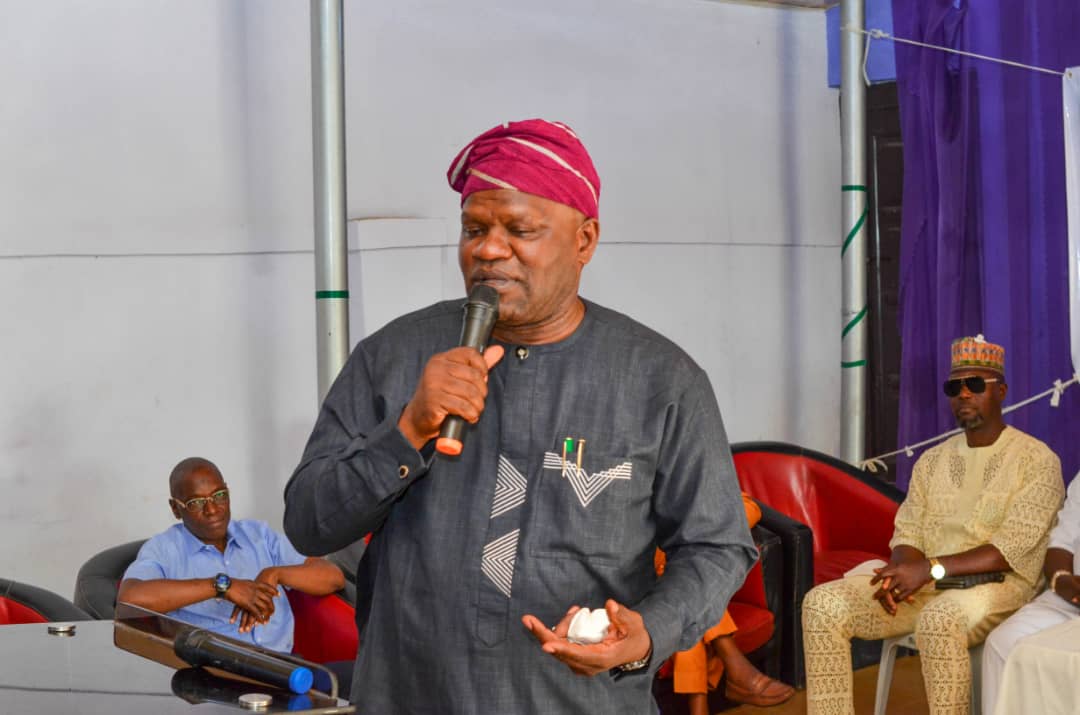
Adeaga: The Architect Transforming Makinde’s Omituntun 2.0 Vision into Measurable Community Change

By Oyo Amebo
In a political climate where public projects are often judged by the scale of their announcements rather than the strength of their impact, a quieter but more consequential shift has taken place across Oyo State.
The real story is not simply that projects have been completed, but that development has been systematised, embedded into communities through deliberate, coordinated intervention rather than episodic display.
Honourable Abideen Tokunbo Adeaga, Chairman of the Oyo State Community and Social Development Agency, whose stewardship of the NG-CARES 1.0 programme has redefined what grassroots governance can look like when planning and execution align.

Rather than concentrate resources on isolated, high-visibility schemes, the agency rolled out micro-projects simultaneously across all local government areas.
This approach avoided the optics of showcase politics and instead reinforced a more demanding principle: that credible governance must be geographically inclusive and socially responsive.
The interventions targeted pressing and practical needs. In education, reconstructed classrooms now offer safe, structured environments that encourage enrolment and help reduce the incidence of out-of-school children.
In healthcare, revitalised centres provide consistent and reliable services, strengthening primary care at the community level. Access to potable water has expanded significantly, contributing to a measurable decline in water-borne diseases.
Meanwhile, previously impassable rural roads have been rehabilitated, restoring links between communities and the markets, schools, and commercial hubs upon which local economies depend.
What distinguishes this programme is not merely its scope, but its method. The emphasis has been on coordination, monitoring, and sustainability, ensuring that each intervention functions as part of a wider developmental framework rather than as a stand-alone achievement.
This philosophy mirrors the broader Omituntun 2.0 agenda of Governor Seyi Makinde, which prioritises resilience, continuity, and long-term structural growth across the state.
Significantly, the completion of the projects was announced during a technical workshop on NG-CARES 2.0 procedures held at the Oyo State House of Chiefs in Ibadan.
The setting underscored the administration’s focus on implementation standards and forward planning rather than ceremonial celebration. Attention was directed towards processes, oversight, and the next phase of delivery.
Adeaga made clear that the initiative was conceived not simply as an emergency response mechanism, but as a strategy to strengthen the social and economic architecture of the state. The objective, he stressed, is to build capacity that endures beyond immediate relief.
Local council leaders, in turn, pledged sustained supervision to guarantee that each completed project remains functional, accountable, and durable.
The cumulative effect is increasingly visible in daily life. Residents no longer speak of development in abstract terms.
They experience it through running taps, operational health centres, safer classrooms, and roads that remain accessible during the rainy season. These are not symbolic gestures; they are structural improvements that alter economic prospects and social outcomes.
In that sense, the NG-CARES programme under Adeaga’s leadership represents more than a portfolio of micro-projects. It offers a working template for decentralised development, one that balances strategy with execution and vision with measurable results.
Across Oyo State, governance is being recalibrated from rhetoric to delivery, and from visibility to verifiability, ensuring that progress is not only promised but practically sustained.
