


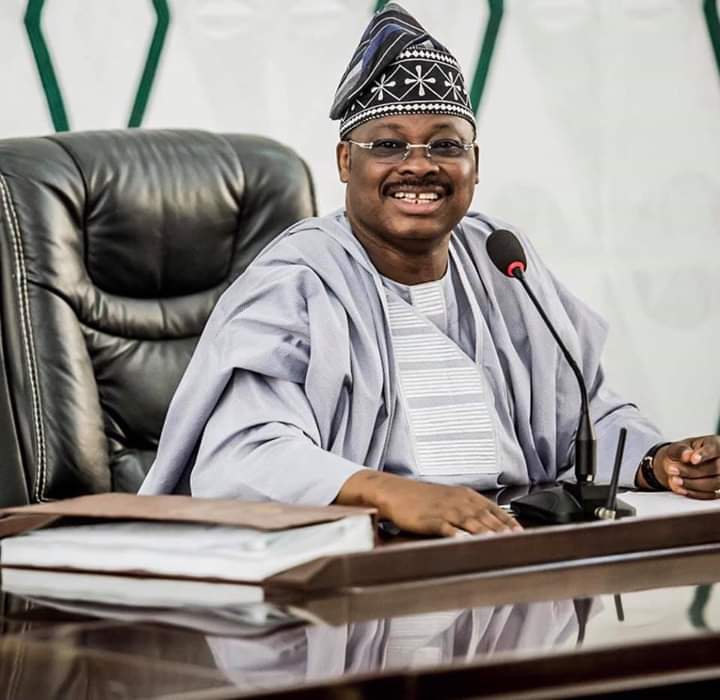
And so, to talk about Ajimobi’s legacy is to delve into a chaos of narratives – the excellent, the good, the bad, and the abysmal. From the young undergraduate (of LAUTECH) who escaped being tear-gassed at the Secretariat, to the Okada rider in Apete who now enjoys his trip to Ijokodo after the government fixed the Apete bridge…Oyo people all have valid stories to tell, and none would cancel the other.
Adegoke Adelabu, the stormy petrel of Ibadan politics, died on the wrong side of the Yoruba ideological spectrum. In the linguistic parlance of those who control the pendulum of public discourse in the region, he was at best “conservative” and at worst “reactionary”. He was no “progressive”. And on the basis of that, very little is said about the man’s brilliance, his charisma, and his aura in politics.

To be sure, even a toddler now understands that in contemporary times, the difference between a “progressive” and “conservative” in South-West politics is akin to that between six and half-a-dozen. After all, if we align to the dominant media narrative in the region, determined largely by partisan politics, Olusegun Mimiko is a “conservative” and Adebayo Alao-Akala is (now) a “progressive”. Such sardonic humour!


But for the purpose of this discourse, we may as well stick to the ideological binary, however pretentiously fictitious it appears today.

In his book, What I Saw in the Politics and Chieftaincy Affairs of Ibadanland, Lamidi Adedibu attempted a fair characterisation of the late Adelabu, acknowledging his aura and brilliance. But that did little in the chaos of narratives, which had the late politician painted solely as the great Awo’s eternal nemesis. And perhaps until recently when his grandson, Bayo, ran for governorship on the platform of a “progressive” party, Adegoke Adelabu remained a mere footnote in the broad narrative. No thanks to the dynamics of the media’s agenda-setting roles in the region, which, over the years, have had enormous influence on peoples’ perception of the different political actors in the region.

(The recent Penkelemesi resurgence in Ibadan, even, remains a study in intriguing complexities: the grandson, Bayo, ran under the banner of the All Progressives Congress (APC), a party controlled by those whose claim to a puritan progressive ideology that, many would argue, remains steeped in controversies. In the end, the oft-trumpeted triumph of interest over ‘friendship/enemity’ in politics played its parts in that instance. But that’s by the way).


Unlike Adelabu, Abiola Ajimobi died a “progressive” – however loosely translated. And so when negative, overtly fictitious, narratives were being peddled online to represent his legacy shortly after his death, some of us stood aloof. After all, the former Oyo helmsman was of the dominant faction of the region’s politics, under whose grip the media operates.
But as hours chameleoned into days, and then weeks, it dawned on me that there appears to be a paradigm shift in the media narrative, and those who we thought had the ultimate influence may indeed be struggling to play catch-up. Of course, the proliferation and liberalisatiion brought by the internet and social media is central to these developments. Hence, it becomes imperative to add one’s voice to the (non-) debate about the place of Ajimobi in Oyo’s contemporary history.
But I consider the years between 2011 and 2015 as Ajimobi’s most productive years as governor. For one, within the period, Oyo State had, perhaps, some of its most brilliant minds in public offices, and a number of notable projects were delivered across the State, warts and all.
Despite being one of our distant “Egbons” in Oja’ba, I saw Ajimobi only once before his death last month, at the grand finale of his 2011 guber campaign in Mapo Hall. In that election, he was ultimately the shoo-in because every politically conscious citizen of Oyo State had had enough of the brigandage, thuggery and killings in the State at the time. We needed a breath of fresh air, and the urbane, suave, well-traveled, educated, outspoken, and intelligent Abiola Ajimobi represented that dream. The ‘Ibadan Parapo’ alliance, the elite conspiracy, and the self-inflicted “Royal rumble” that eventually nailed Alao-Akala’s fate at the polls, only came to accentuate the dominant mood of the people. Ajimobi would go ahead to win a second term in office, making a mess of the myth that no governor enjoys such luxury in Oyo State, and that Ibadan does not serve anyone twice (Ibadan e sin’yan l’eemeji). He was christened “Koleseri”.
But I consider the years between 2011 and 2015 as Ajimobi’s most productive years as governor. For one, within the period, Oyo State had, perhaps, some of its most brilliant minds in public offices, and a number of notable projects were delivered across the State, warts and all. I remember now that shortly after the 2011 elections, too many bridges collapsed in different parts of the State, including the one at Apete, where we dwelled as Polytechnic Ibadan students. The government would go ahead to fix the bridges, including the one at the flooded section of the Awolowo-Secretariat Road, which reportedly claimed lives and was a nightmare for residents in the years prior. Apart from bridges, he did quite well in road construction across parts of the State, too.
In those years, there was also a strategic, conscious attempt to ‘intellectualise’ and bring decency into the entire governance architecture in the State, as seen in the numerous lectures that the governor delivered in universities across Nigeria and beyond. Today, those steps may appear tokenish, inconsequential even, but I was particularly proud of those moments. For a State notorious for thuggery and “Amala and Gbegiri politics” at the time, those who care about optics and its import in governance and development would acknowledge that it was an all-important step that changed the face of governance in the State.
The promise of the years after 2015 was marred by a number of factors, notably Ajimobi’s own metamorphosis and complete descent into the dirty waters of partisan politics. And governance suffered for it. In the years that followed, all of these would snowball into administrative lethargy, worsened by the ripple effects of the divisive politics of 2015 and battle for the soul of the Oyo APC ahead of 2019, the economic recession that affected revenue and slowed growth, and, of course, Ajimobi’s descent into the pit of megalomania. It is then no surprise that all incidents cited by those who would rather have the late governor’s legacy ‘cancelled’ occurred within these years: The Olubadan chieftaincy kerfuffle; the occasions he brought avoidable criticisms upon himself with his trademark loquacity; the needless grandstanding and shouting match he had with LAUTECH students; the Yinka Ayefele Music House debacle and its needless drama, etc.
When you add all of these to the pains of those who suffered unpaid pension arrears and civil servants who lived in penury without payments in the autumn of his second tenure, you have that lethal weapon with which Ajimobi’s traducers could malign him to no end, and, to some degree, justifiably so.
But it’s equally important to point out that, in a country where emotions easily trump logic, the issues were treated largely with emotionalism. While it remains indisputable that Ajimobi could and should have handled the concerns better, a careful dissection of the issues may come with the realisation that the problems were way deeper than they appeared on the surface. For instance, the Olubadan chieftaincy affair was a well-intentioned reform messed up by a controversial tactic and poor communication; the Ayefele debacle ought to have begun the way it eventually ended, after both parties had been locked in a needless war of ego; and the jury is out on the LAUTECH debacle and what it would take to indeed fix the rot in that school, beyond empty sloganeering.
When he died in June, peoples’ opinions were sharply divided into two radically contrasting extremes: An extremist demonisation and emotive beatification. There was no middle ground. It was as though it was a crime to stand in the midriff of history, dissecting his legacies from a chaos of narratives, highlighting the strengths and weaknesses. Yet, legacy needs not be uni-directionally absolute before it could be considered representative of actual reality. For, the human legacy is too complex, too chaotic, too fluid, to be couched in absolutism. In the case of a public office holder, the complexities become even more problematic.
And so, to talk about Ajimobi’s legacy is to delve into a chaos of narratives – the excellent, the good, the bad, and the abysmal. From the young undergraduate (of LAUTECH) who escaped being tear-gassed at the Secretariat, to the Okada rider in Apete who now enjoys his trip to Ijokodo after the government fixed the Apete bridge, to the old pensioner in Iyaganku who wept for years without being paid, to the innocent resident of Iwo Road who lived safely in his neighbourhood without the spectre of guns and bullets – Oyo State people all have valid stories to tell, and none would cancel the other.
For me, Ajimobi remains Oyo State’s gutsiest governor of this republic, who indeed left his footprints on the sand of time but, with his uncommon courage, could have delivered much more than he did. Adieu.
Oladeinde tweets via @Ola_deinde. Email: Olawoyinoladeinde@gmail.com
Source: PREMIUM TIMES
