
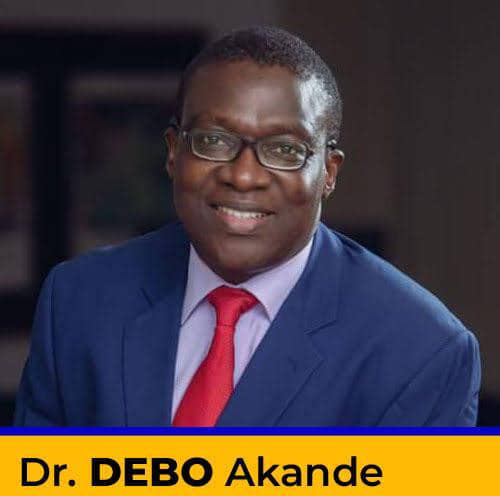

By Oyo Amebo
For decades, agriculture in many subnational economies has been treated as a closed loop: production begins and ends at the farm gate, measured by output volumes and local market circulation. In Oyo State, that narrative was decisively altered under the leadership of Dr Debo Akande.

Agriculture was no longer managed as a routine sector of government, but recalibrated as a strategic platform through which the state could engage international capital, technology and markets.

Akande’s intervention did not revolve around expanding acreage or chasing short-term yield gains. Instead, it focused on redefining purpose. Agriculture was repositioned as a connector, linking local productive capacity to global agribusiness systems, trade standards and investment flows.

Through this reframing, Oyo State began to project itself beyond Nigeria’s borders as a credible participant in international agricultural commerce, not merely a supplier at the margins.
This approach marked a clear departure from conventional public-sector agriculture management. Rather than treating the sector as an isolated portfolio, Akande embedded it within a broader economic and diplomatic context.
Farms were no longer viewed as endpoints of policy, but as entry points into structured value chains where processing, logistics, compliance and market access mattered as much as cultivation itself. Agriculture became an interface between rural productivity and global economic architecture.
At the heart of this transformation was a calculated expansion of Oyo State’s external engagements. International outreach was neither symbolic nor episodic. It was systematic, purposeful and aligned with clearly defined development objectives.
Engagements with foreign governments, development finance institutions, multinational agribusinesses and trade bodies were sequenced to reinforce one another, each forming part of a wider economic strategy.
Agreements were approached as working instruments rather than ceremonial milestones. Discussions on investment were grounded in demonstrable capacity: available land banks, emerging agro-industrial zones, improving infrastructure, regulatory coherence and institutional readiness.
The signal to external partners was unambiguous, Oyo State was not seeking speculative interest, but long-term, rules-based collaboration compatible with modern agribusiness expectations.
This outward-facing posture was firmly anchored in the development philosophy of Governor Seyi Makinde, whose administration elevated agriculture from subsistence thinking to industrial relevance. Akande functioned as the principal translator of that vision, articulating it in terms that resonated with international stakeholders.
His argument was consistent: sustainable agricultural growth is driven by processing capacity, logistics efficiency, value addition and organised markets, not raw production alone.
What gave credibility to this narrative was its tangible expression on the ground. International partnerships were not pursued in isolation from local reform. Agro-industrial zones were expanded and better integrated. Production systems adopted modern practices.
Transport and logistics links improved. Crucially, foreign investment was positioned to reinforce, rather than overwhelm, domestic enterprise, accelerating scale while strengthening local institutions.
Under this model, agriculture was woven into a wider industrial ecosystem.
Farms fed into factories; factories connected to markets; and markets were linked to national and cross-border transport corridors. This integration shifted agriculture from a seasonal activity into a continuous economic process with predictable outcomes and measurable returns.
Akande was equally intentional about the quality of international cooperation.
Financial inflows were important, but they were not the sole objective. Engagements emphasised technology transfer, quality control, standards alignment and export preparedness.
Partnerships with European and African trade institutions supported compliance with global requirements, while alignment with the African Continental Free Trade Area placed Oyo’s producers within an expanding continental market framework.
The consequence was a fundamental change in expectations at the local level. Farmers were no longer producing solely for informal or nearby markets.
They became actors within structured value chains designed for regional and international trade. The emphasis shifted decisively from volume to value, from isolation to integration, and from potential to performance.
The Oyo State International Agribusiness Summit emerged as the most visible demonstration of this orientation. Yet it functioned less as a promotional event than as a validation exercise. International participants encountered systems that were already operational, not aspirational concepts awaiting implementation.
Policy coordination, infrastructure development and institutional alignment had been advanced well ahead of the summit, reinforcing confidence in the state’s seriousness and preparedness.
Importantly, this global engagement never lost sight of its local foundation. International partnerships were consistently framed as tools for community development. Farmers, processors and rural economies remained central to the strategy.
By linking global market access to job creation, income stability and rural livelihoods, Akande ensured that diplomacy translated into tangible social and economic outcomes. Over time, the results of this navigation became clearer.
Farmers were integrated into organised value chains supported by international capital and expertise. Agro-industrial zones achieved stronger connectivity to national infrastructure.
Regulatory frameworks reflected a growing sophistication in responding to global trade realities. Oyo State demonstrated not only its capacity to attract partnerships, but the institutional maturity required to sustain them.
What ultimately took shape was not a single policy or flagship event, but a replicable method. Akande’s work illustrated how subnational leadership can engage confidently with global systems without abandoning local priorities.
Agriculture, under his stewardship, functioned simultaneously as an economic driver and a diplomatic signal, announcing Oyo State as a serious, investment-ready player in international agribusiness.
In navigating this course, Oyo cultivated more than agricultural output. It cultivated credibility, enduring partnerships and strategic relevance. Dr Debo Akande’s legacy, in this regard, lies in demonstrating how thoughtful, disciplined leadership, rooted in local capacity yet oriented towards global opportunity, can reposition a region within the evolving landscape of international agribusiness.
