


By Oyo Amebo
In Egbeda, political conversations are beginning to take on a different tone, less speculative, more deliberate.

Beneath the usual currents of party positioning and constituency interests, a distinct question is gaining ground: what kind of leadership can genuinely translate potential into progress?
That question is increasingly accompanied by another: what does it take to rally behind a candidate whose capacity is already evident?
For many within the constituency, the moment appears to call not just for observation, but for support, measured, intentional, and rooted in a desire to see tested competence brought into public service.

The argument gaining traction is straightforward: if leadership is to improve, then credible options must be recognised early and strengthened collectively.
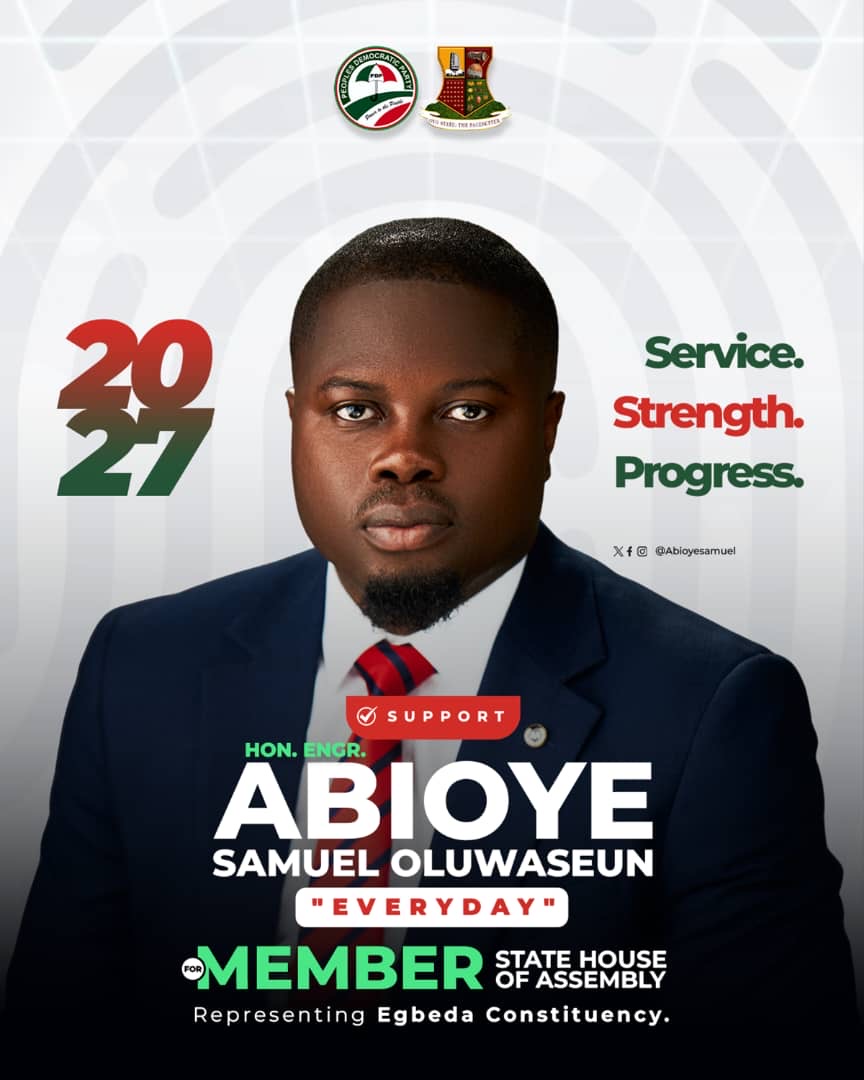
Increasingly, that conversation is being framed around Engr. Abioye Samuel Oluwaseun.

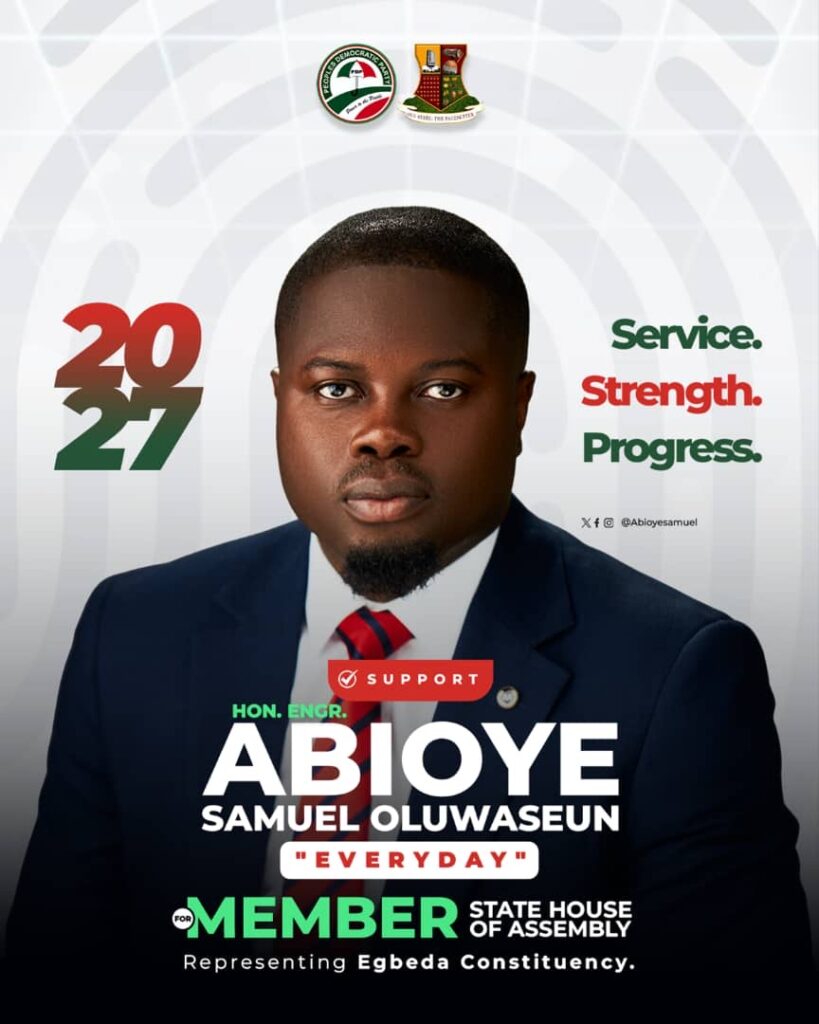
Known widely for his role as the driving force behind Everyday Kitchen, Abioye’s professional journey offers a narrative that extends beyond commercial success.
What started as a modest business venture has evolved into a widely recognised enterprise, with a presence across Ibadan and a workforce that reflects both scale and structure.
In practical terms, this growth has meant employment, skills development, and economic activity for hundreds, outcomes that resonate far beyond the balance sheet.
Yet, it is not the business alone that is drawing attention. Rather, it is what that experience suggests about capacity, an ability to build, manage, and sustain systems that function efficiently while remaining responsive to people.
Within the Peoples Democratic Party (PDP) in Egbeda, conversations around his potential candidacy have become increasingly pronounced.
Party stakeholders and community voices alike appear aligned in their search for a shift from familiar patterns of representation towards something more grounded and outcome-driven.
This sentiment is not without context. For many residents, the gap between expectation and delivery in past leadership has been difficult to ignore.
What is emerging now is less about personality and more about performance, about identifying individuals whose track record offers a credible basis for public trust.
Abioye’s appeal, in this regard, is shaped largely by his activities outside formal office. His engagement within communities, through employment opportunities, support initiatives, and direct intervention, has established a presence that feels both practical and accessible. It is a model of influence built not on office, but on action.
When he recently addressed growing calls for him to enter the political space, his response was measured rather than declarative.
There was no urgency to claim ambition, but a clear acknowledgement of responsibility, an indication that leadership, if pursued, would be approached with deliberation rather than impulse.
Observers point to a convergence of qualities: organisational discipline from the private sector, familiarity with political structures, and an existing connection to grassroots realities. Together, these suggest a readiness that is less theoretical and more demonstrable.
Across Egbeda, the conversation continues to evolve. It is no longer confined to whether change is needed, but increasingly focused on who is equipped to deliver it—and how.
In that unfolding discussion, Engr. Abioye Samuel Oluwaseun occupies a growing space. Not as a finished answer, but as a compelling proposition, one that reflects a broader shift towards leadership defined by competence, accessibility, and measurable impact.
Whether or not he ultimately steps forward, his emergence has already altered the terms of engagement.
In Egbeda, expectations are rising, and with them, a renewed insistence that leadership must be earned not through promise, but through proof.
