


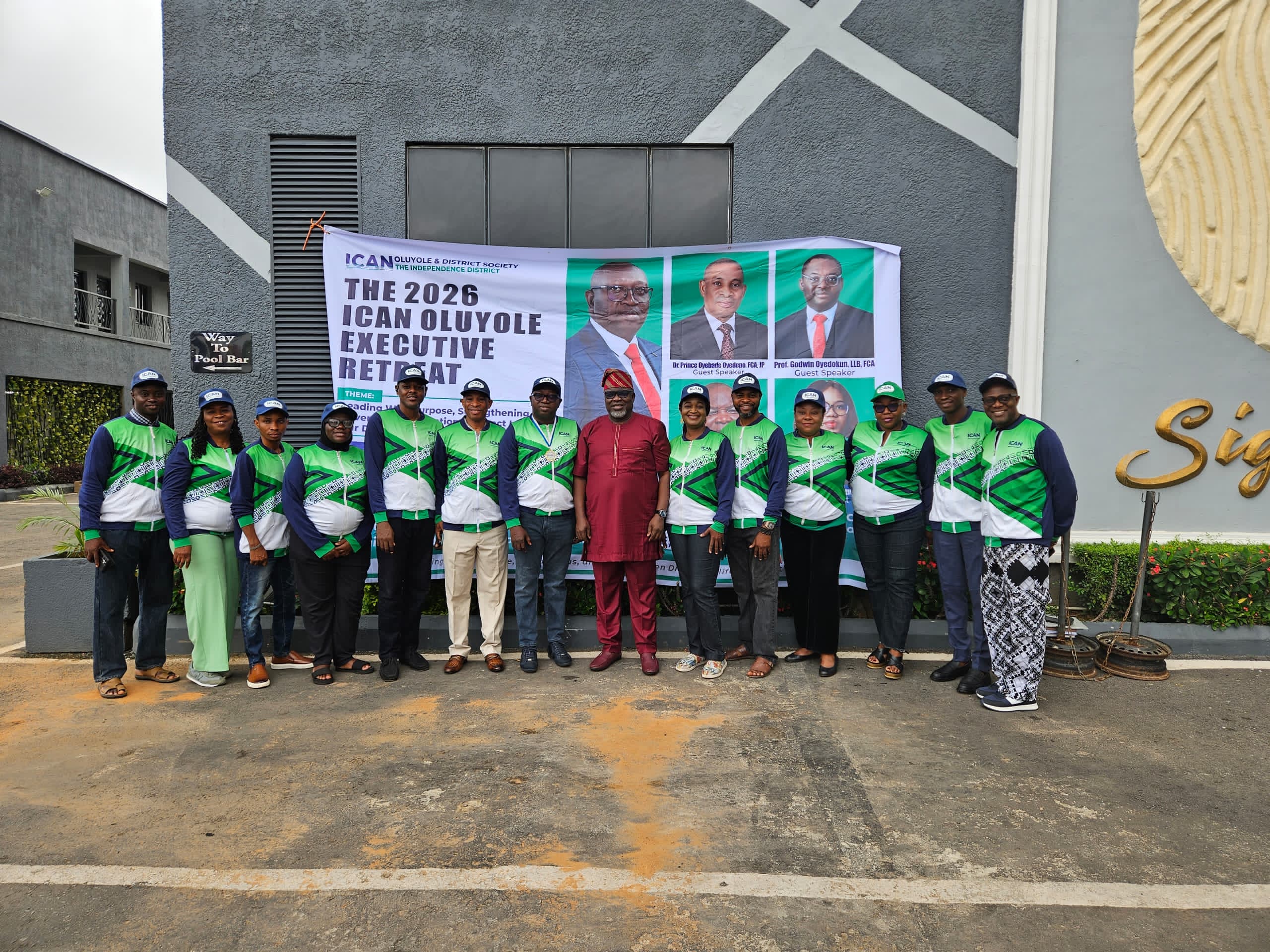
The President of a Multidisciplinary Finance Professionals Group under the aegis of MFP Group Nigeria and MFP Global Services, Dr Prince Oyebade Oyedepo, FCA, JP delivered a paper on the topic titled; Succession Planning and Leadership Sustainability: Identifying, Mentoring and Preparing Future Leaders to ensure continuity and growth at the Leadership Retreat Organized by the Oluyole & District Society of ICAN over the weekend.

Oyebade opines that succession planning and leadership sustainability is fundamental in management and business continuity. According to him, “succession planning and leadership sustainability are interconnected and interrelated. The concept is all about having effective leaders and managers per time that can deploy human and material resources of the organization to sustain growth”.



In his words, “many organizations have risen in the past but crumbled, many empires have been built but collapsed and many Nations have attained stardom but lost reckoning for want of successors or ill-prepared successors. All these underscores the essence of succession planning and leadership sustainability particularly in a competitive environment and challenging economic situation all over the world”.



The MFP top brass opines that, “leaders and successors are drawn from people within the society and workplace. This implies that without people, there cannot be leaders and successors. However, people are different in approach, traits and behaviours as a result of upbringing, educational status, exposure and conviction.

The divergent nature of man sometimes or mostly affects reasoning and job performances. Having the knowledge of the differences we have in people will substantially help to know how to relate with them and identify the good from the bad”.
He cited Tim LaHaye (1984) to buttress his position that, people can generally be classified into four major temperament types: Sanguine, Choleric, Melancholic, and Phlegmatic. Each temperament possesses unique strengths and weaknesses that affect leadership style, decision-making, communication, and interpersonal relationships.
Understanding these temperament categories is important for identifying, mentoring, and preparing future leaders.
He opines that, identifying successors is a big task; it is an arduous responsibility by leaders. It is therefore imperative for leaders to possess some qualities which will enable them make effective judgements in the performance of the responsibility. Some of these qualities include having integrity, being unbiased, having time and energy, being knowledgeable, understanding the whole picture of the organization and their dreams, being large-hearted, being approachable, understanding the nature of man, tolerance and patience,
According to Rothwell (2010), effective succession planning requires a systematic process for identifying individuals who can successfully occupy key positions when vacancies occur. Rothwell postulates the following procedures; performance assessment approach, potential assessment approach, competency-based assessment, management by observation, mentoring and coaching programmes, 360-degree feedback approach, psychological and personality assessments.
Other approaches that can be deployed according to Oyebade Oyedepo (2026) are; head-hunting, referrals, contributions at meetings or forums and exhibited behaviour during crisis.
The process of mentoring and preparing successors involves a systematic approach of developing, guiding, and equipping individuals with the competencies required to assume leadership positions in the future after identifying them.
The following are the major processes involved according to Rothwell (2010); establishment of mentoring relationships, provision of coaching programmes, leadership training and development, delegation of responsibilities, and continuous performance feedback.
The MFP top notch mentioned that identifying good successors is one of the most difficult aspects of succession planning and leadership sustainability. The following are some of the major challenges associated with identifying good successors;
i. Difficulty in assessing leadership potential (Rothwell (2010)
ii. Bias and favoritism (Armstrong 2021)
iii. Resistance from existing leaders (Rothwell 2010)
iv. Rapid changes in organizational needs (Drucker 2007)
v. Limited development opportunities (Armstrong 2021)
The following are the major benefits of identifying, mentoring, and preparing future leaders or successors;
i. Ensures leadership continuity (Rothwell 2010)
ii. Enhances organizational stability (Armstrong 2021)
iii. Improves employee motivation and engagement (Dessler 2020)
iv. Reduces recruitment and training costs (Armstrong 2021)
v. Promotes employee retention (Noe 2020)
vi. Strengthens organizational culture (Armstrong 2021)
vii. Ensures long-term organizational growth and sustainability (Hargreaves and Fink 2006)
viii. Promotes adaptability and innovation (Hargreaves and Fink 2006).
ix. Encourages effective decision-making
in conclusion, Oyebade opines that, “Certain factors are destructive to business survival; they may be controllable but over looked or uncontrollable due to overwhelming circumstances. The factors may be weighty to create serious challenges for the organization. This shows the gravity of some problems to the continued survival of any organization.
However, the greatest of challenges is inability to have successors to sustain performances. The absence of successors crumbles the structure and the fabric of the organization. It is not only destructive but completely devastating. That is why any wise organization should invest massively in identifying and building the successors for sustenance.
The successors of leaders have the ability to combat controllable challenges and ameliorate uncontrollable challenges to maintain steady growth and development. In order words, identifying, mentoring and preparing successors is the most potent tool to build an organization and sustain it for the benefits of the stakeholders in particular and the Country as a whole”.
This year’s leadership retreat of Oluyole & District Society of ICAN was attended by two distinguished council members of the Institute, Elder Gbenga Omidiji, PhD, FCA and Mrs Laitan Babatunde, FCA. The two council members made great speeches at the event.
The Chairman of the district, Dr Olawale Dopemu, FCA made a powerful presentation to stimulate thoughts. Professor Godwin Oyedokun, FCA equally facilitated at the event as a guest speaker. The leadership retreat was attended by the executives of the district led by Dr Olawale Dopemu, FCA (Chairman), Mr Simon Awotoye, FCA (Vice Chairman), Mrs Tolulope Olatoyan, FCA (General Secretary), other executive committee members, Chairmen of Committees and Sub Committees of the district.
