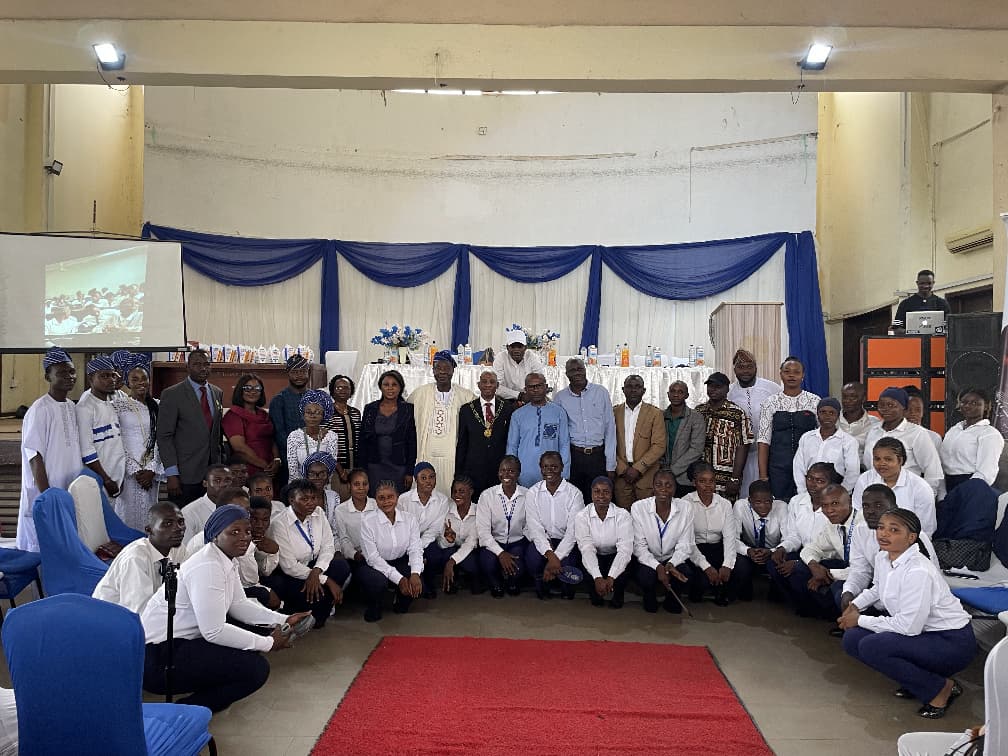
The President of the Multidisciplinary Finance Professionals Group (MFP), Dr Prince Oyebade Oyedepo, FCA, JP, has emphasized that automation of processes should be matched with integrity to produce a perfect outcomes.
The MFP topbrass made this statement when presenting a paper titled, Trust Equation: Integrity in the Age of Automation at the Corporate Bankers Club (CBCB) 23rd Set Induction Ceremony and Awards, The Polytechnic Ibadan Chapter today held in the Assembly Hall, North Campus of the Instititution.
In his words, Trust is the master key that sustains personal relationship between individuals, organization and people, employers and employees and government and people. Trust enhances relationship and strengthens bond. It is the factor upon which everything is premised. If trust is earned, it is worth more than currency. One of the ways to earn trust is integrity among others. Trust is old as human creation. It has been there from time immemorial. Trust can be earned, sustained and lost. Trust is earned through the display of many virtues to stand you out. It can be sustained by the continuous display of the same virtues. It can be lost by the absence of the same virtues which made it to be earned. Trust has operated under different dimensional systems such as the stone age, manual age, computer age, advanced computer age, and now automation age. Despite different dimensional systems, the drivers of trust which are the people and the qualities expected of them are constant.
The MFP topnotch added that the trust equation model was developed by David Maister, Charles Green, and Robert Galford in their book titled The Trusted Advisor, first published in 2000. The model proposes that trust can be represented mathematically as a function of four variables: credibility, reliability and intimacy, which sit in the numerator, divided by self-orientation, which forms the denominator, expressed as an equation.
Trust = (Credibility + Reliability + Intimacy) ÷ Self-Orientation (Trusted Advisor Associates, 2026)
He emphasized that the component of integrity includes Consistency, Accountability, Ethical decision-making, Fairness and respect for others. He proceeded to list the types of automation which are; Fixed Automation, Programmable Automation, Flexible Automation and Robotic Process Automation.
The President of the MFP Group also described the various ways in which Automation can Infringe on Trust Equation and Integrity which are; Impact on Credibility, Impact on Reliability, Impact on Intimacy, Impact of Self-Orientation, Automation, Bias and Objectivity, Automation, Confidentiality and Privacy, Automation and Accountability, Automation and Professional Judgment, Automation and the Risk of Over dependence, AI-Generated Errors and Misleading Information.
Dr Prince Oyebade Oyedepo went further to discuss how enforcement of integrity can limit automation performance which includes Integrity may require human intervention, Integrity May Require Professionals to Reject an Automated Output, Integrity May Restrict the Use of Confidential Information in Automation, Integrity May Limit Automation Where There Is Bias, Integrity May Reduce the Speed of Automation, Integrity May Prevent Full Automation of Professional Judgment, Integrity May Require Transparency About the Use of Automation.
He suggested on how to manage the trust equation and integrity in the age of automation as; Establish Strong AI and Automation Governance, Maintain Human Oversight, Validate Automated Systems Regularly, Protect Confidential Information, Strengthen Professional Competence, Preserve Professional Skepticism, Improve Transparency, Create Clear Accountability Structures, Embed Ethical Principles into Technology Design, Reduce Excessive Self-Orientation, Develop a Culture of Integrity, Conduct Periodic Independent Reviews, and Make Trust a Performance Objective
In his words, “Technology can process, predict, and automate but it cannot be trusted. “The organizations that will truly endure are those that place integrity at the centre of every algorithm, every decision, and every client relationship. The age of automation has expanded the capacity of professionals to deliver faster and smarter outcomes, it has simultaneously created a trust deficit, a growing gap between what technology can do and what clients feel they can rely on. That gap can only be bridged by professionals who refuse to let efficiency eclipse ethics”.
Dr Oyebade Oyedepo challenged the inductees to see themselves not merely as operators of financial tools, but as stewards of public confidence — insisting that in a world where machines can do almost everything, the one thing they cannot do is take responsibility. And that, he said, is where the human professional becomes indispensable.
The ceremony, which drew distinguished guests, faculty leaders, and industry stakeholders, also featured the induction of new members and the presentation of awards to outstanding individuals within the Corporate Bankers Club and the MFP President, Dr Prince Oyebade Oyedepo.
The event was graced by many topnotch personalities in the banking and accountancy professions including Mogaji Alhaji Dr Abdullahi Alade FCIB, FCA Patron Corporate Bankers Club; Dr. Rose Ozegbe, HOD, Banking & Finance, University of Ibadan; Dr. Paul Adu, NAMBSS Chairman, ACIB, CIBN Oyo State Branch; Mr. Femi Adegbolahan, ACIB, ACA, CIBN Oyo State Branch; Mrs. Oriola Racheal, ACIB, ACA, CIBN Oyo State Branch; Hon. Adebowale Adeyoju; Mrs. Olalekan Oluwaseun, Student Advisor, Banking & Finance Department, The Polytechnic, Ibadan; and Dr. Ifeanyi Onwuka, ACIB, Former HOD, Banking & Finance, University of Ibadan among others.