


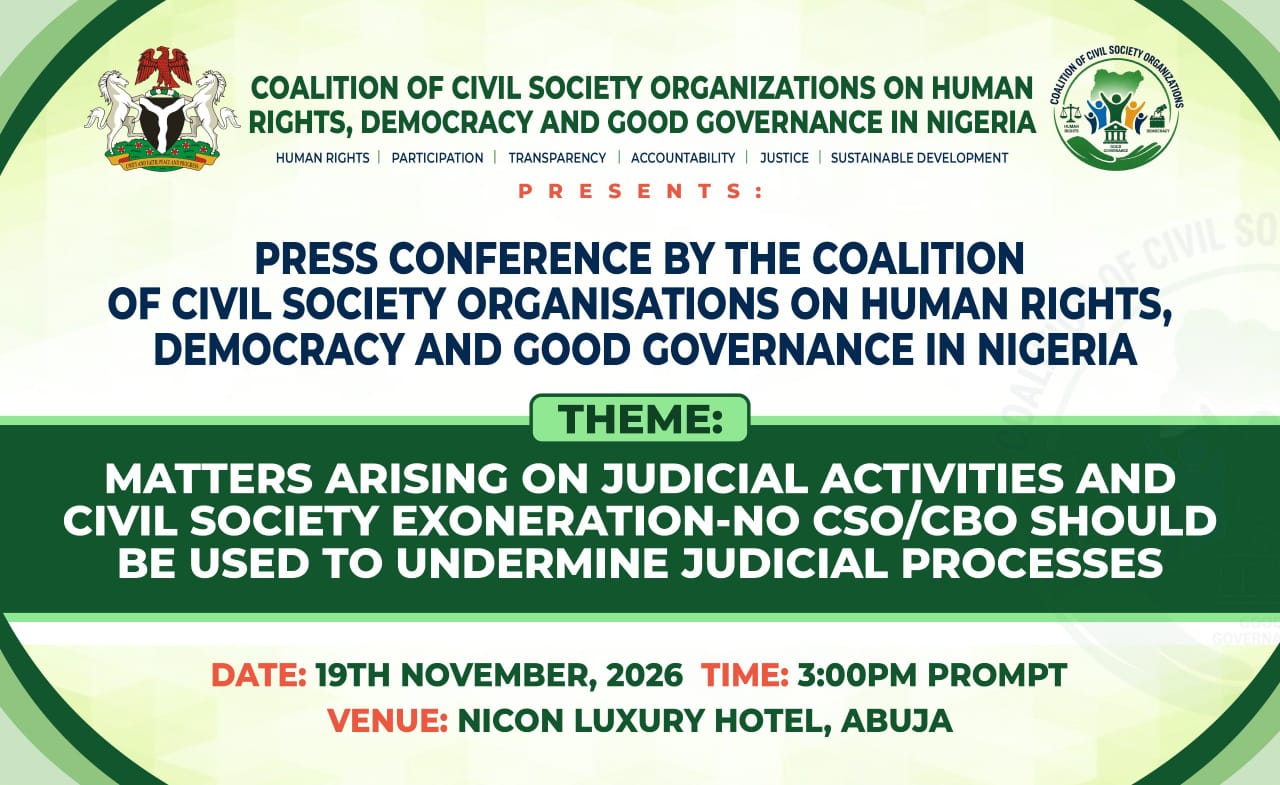
The Coalition of Civil Society Organisations on Human Rights, Democracy and Good Governance in Nigeria has cautioned civil society organisations (CSOs) against using advocacy platforms to interfere with ongoing judicial proceedings, warning that presenting paid legal defence as independent civil society advocacy could undermine public confidence in the judiciary and the credibility of the civic space.



The coalition issued the warning on Thursday in Abuja during a press briefing themed, “Matters Arising on Judicial Activities and Civil Society Exoneration.”

Speaking on behalf of the coalition, its Secretary, Mr Peter Nwokolo, described the group as a non-partisan and independent convergence of organisations committed to democratic values, judicial integrity, the rule of law and the protection of civic space.



Nwokolo said the briefing was organised to defend the integrity of both the judiciary and civil society, while drawing a distinction between legitimate advocacy and activities capable of influencing or obstructing judicial proceedings.

He explained that civil society organisations were expected to serve as independent voices of the people by monitoring the exercise of state power, promoting the rule of law and equal access to justice, and defending citizens’ fundamental rights and dignity.
According to him, their responsibilities also include demanding transparency, accountability, participation and fairness in public governance, as well as exposing and resisting corruption in all its forms.
The coalition expressed confidence in the Nigerian judiciary’s ability to dispense justice without fear or favour, insisting that protests and media trials should not be allowed to derail the judicial process.
“An accusation is not a conviction. An investigation is not persecution. Every citizen invited by the courts or anti-corruption agencies must submit to due process, with full respect for the presumption of innocence and the right to a fair hearing,” Nwokolo said.
The coalition also disclosed that its members had observed proceedings in the case of the Federal Republic of Nigeria versus Mr Ufoma Joseph Immanuel and Intermediate Investment Holdings Limited before Justice Mojisola Dada of the Special Offences Court, Ikeja, Lagos. The case involves an alleged $1.5 million fraud.
Giving an account of the proceedings, Nwokolo said that on November 16, 2026, the prosecution informed the court that it had written to the Lagos State University Teaching Hospital (LASUTH) to verify a medical report submitted in support of the defendant’s bail application.
He said the prosecution further informed the court that LASUTH, in a response dated July 22, 2026, stated that the medical report did not originate from the institution.
Nwokolo added that on November 18, 2026, the court dismissed the fresh bail application, ordered an accelerated hearing, granted the defendant 30 days to engage new counsel and adjourned the case until January 25, 2027.
He stressed that the defendant had pleaded not guilty and that the coalition was not making any pronouncement on his guilt or innocence, noting that the responsibility for determining the matter rested solely with the court.
According to the coalition, its members observed the proceedings alongside other organisations, including the Support for Civil Society Organisations Initiative, Centre for Leadership and Democratic Ethics (CELDE), The People’s Care and Development Initiative, and Elorah Initiative Hub.
Raising concerns about the conduct of some civil society groups in matters before the courts, Nwokolo maintained that advocacy organisations must stand with the people and the Constitution rather than engage in activities capable of obstructing justice.
He warned that protests organised to interfere with ongoing trials could undermine the moral standing of civil society organisations and further restrict the civic space.
The coalition also cited the position of the National Leadership of Accredited Civil Society Organisations in Nigeria (NLOACSO), stating that the body would query and investigate, and where necessary sanction, any CSO, community-based organisation, faith-based organisation or NGO found using the civic space to promote illegalities, obstruct judicial processes, engage in media trials or portray paid legal defence as independent civil society advocacy.
Nwokolo also referred to the late Dr Tunji Braithwaite, SAN, whom he described as a respected figure in Nigeria’s democratic and legal history.
He said the coalition had observed public statements issued in the name of the Braithwaite Foundation concerning the case and called on the organisation to clarify whether the publications represented its official position.
The coalition’s leadership urged the Foundation to respect judicial independence and uphold the integrity of the civil society constituency, adding that transparency was necessary where questions arose about the roles of organisations or individuals in pending court cases.
It further maintained that any defence of an accused person should be presented before the court through properly briefed legal counsel, openly and on the record.
In its concluding remarks, the coalition urged the judiciary to remain steadfast, courageous and impartial in the discharge of its responsibilities. It also called on the Economic and Financial Crimes Commission (EFCC) and the Independent Corrupt Practices and Other Related Offences Commission (ICPC) to carry out their mandates professionally without resorting to media trials.
The media was equally urged to resist being used to promote narratives capable of undermining judicial proceedings, while professional bodies were asked to examine the propriety of dual roles in line with the applicable Rules of Professional Conduct.
“We will support no criminal, and we will oppose no innocent person. We stand with the law,” Nwokolo said.
The coalition also advised persons under investigation to approach the courts to clear their names rather than sponsor actions that could lead to public disorder.
