By Oyo Amebo
Often times, politics is shaped by distance, between government and governed, power and people; significant shift usually takes place. It is driven not by slogans or spectacle, but by a renewed sense of connection between the legislature and the citizens it exists to serve.
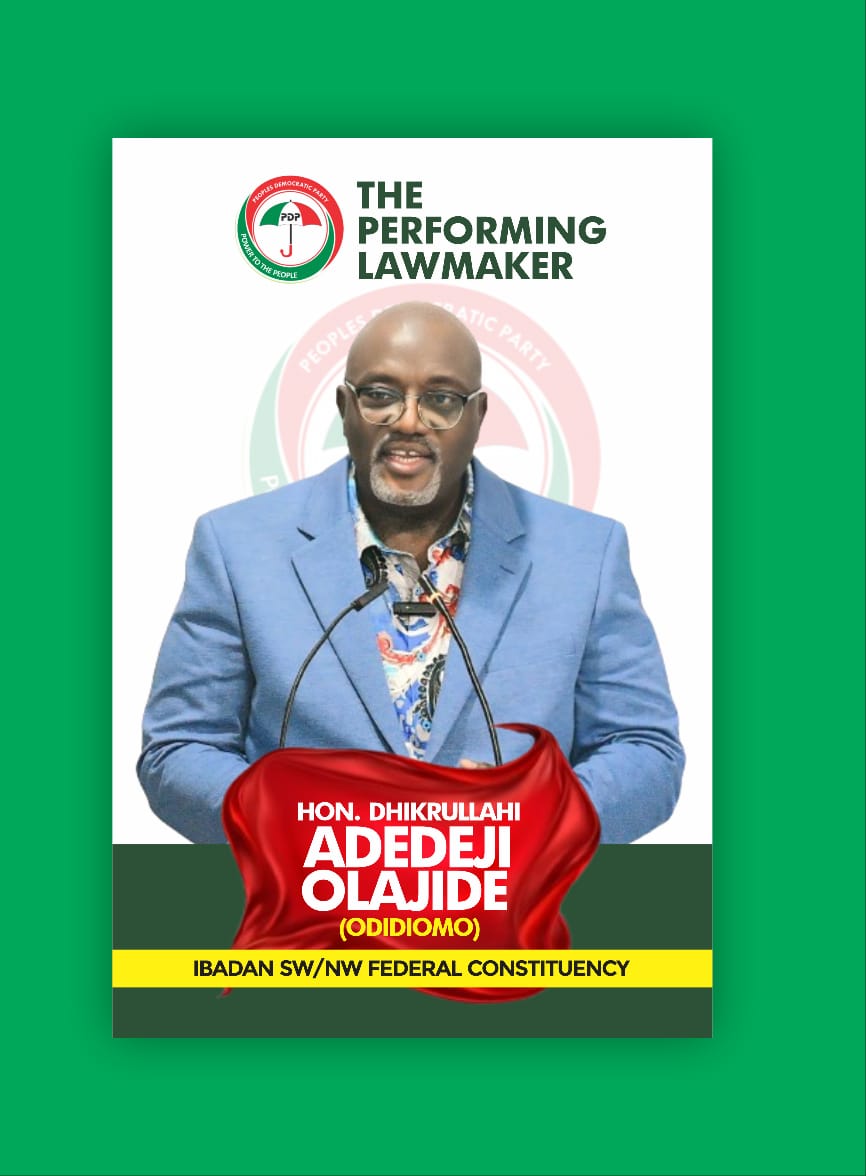
This shift finds expression in the political philosophy and practice of Honourable Adedeji Dhikrullahi Stanley Olajide, known affectionately across Ibadan and beyond as ‘Odidiomo.’
His model of leadership offers a refreshing argument for what democracy can look like when representation becomes a partnership rather than a performance.
For him, lawmaking begins not in Abuja’s echoing chambers, but in the markets, schools, and neighbourhoods of his constituency. Every bill, motion, and oversight function is informed by lived realities, not distant assumptions. Odidiomo treats legislative work as an active conversation, an ongoing dialogue between the aspirations of citizens and the duties of governance.
His rise to prominence did not begin in the corridors of power but in the heart of civic activism. Long before assuming office, he was a familiar voice in Ibadan’s grassroots movements, demanding better public schools, equitable access to healthcare, and improved community infrastructure. These early commitments have since evolved into a legislative agenda shaped by empathy, inclusion, and accountability.
In the National Assembly, Odidiomo has become known for pursuing laws and motions that strengthen everyday lives, from education reforms to youth empowerment initiatives, from community-driven development projects to frameworks that demand fiscal transparency.
Each intervention underscores a simple but profound belief: that governance must first make sense to the people it governs.
But what sets him apart is his refusal to let representation end with policy formulation. He treats oversight not as a technical obligation but as a civic duty, ensuring that government promises are matched with tangible outcomes.
Through regular constituency meetings and public accountability sessions, he transforms transparency into a habit of governance, not a headline gesture.
In a political culture where secrecy is often mistaken for strength, Odidiomo’s insistence on openness disrupts convention. His leadership style has inspired a new rhythm of trust between public office and private citizens, proving that honesty, not rhetoric, is the truest form of influence.
Equally striking is his redefinition of empowerment. Rather than the typical handouts that fade as quickly as they appear, he invests in systems that sustain growth: scholarships for students, training centres for artisans, business grants paired with mentorship programmes, and infrastructural upgrades that revive local economies.
These are not acts of charity but instruments of policy, deliberate efforts to create independence, not dependency.
The outcomes are tangible. Roads once impassable now connect communities again; classrooms that once stood in neglect now host eager learners; health centres once deserted now serve the vulnerable.
These transformations are not mere statistics, they are proof that when legislation listens, development responds.
Beyond his constituency, Odidiomo’s approach raises a pressing question for Nigeria’s democratic evolution: what should representation truly mean? For decades, the country’s political conversation has been dominated by those who speak for the people, rarely with them.
His example suggests that this imbalance can be corrected, that governance, when grounded in listening and participation, can rebuild faith in institutions long dismissed as distant or self-serving.
Odidiomo’s model offers a hopeful counter-narrative. It shows that democracy’s renewal does not require grand revolutions but steady, sincere reconnections between power and purpose.
And perhaps that is the lesson Nigeria most needs to learn, that the strength of democracy lies not in how loud its leaders speak, but in how well they listen.