By Oyo Amebo
As the final pages of 2025 are being written, Oyo State offers an instructive lesson in how progress truly takes root.
Away from the spectacle of grand announcements and political theatre, a subtler transformation has been unfolding, one shaped not by distant authority, but by the steady resolve of ordinary people.
Over the course of the year, development in the State gradually shed its traditional top-down character and assumed a more grounded, participatory form, revealing what becomes possible when communities are trusted to chart their own course.
Looking back, this shift did not occur by accident. It was the product of a deliberate rethinking of how governance meets society, embodied in the work of the Oyo State Community and Social Development Agency.
Under the leadership of Honourable Abideen Adetokunbo Adeaga, the agency’s activities throughout the year demonstrated that sustainable development is less about imposing solutions and more about enabling voices.
Citizens were no longer positioned as passive recipients of state benevolence, but as partners whose insight and commitment shaped outcomes from conception to completion.
Across towns, villages and peri-urban settlements, community meetings replaced assumptions. Mothers, elders, youths and local leaders collectively identified priorities, debated options and accepted responsibility for the results.
By the close of 2025, more than 250 community-driven micro-projects had been executed, reaching over 350,000 people across Oyo State.
Yet the true measure of success lay not in the scale alone, but in the everyday changes these initiatives delivered: clean water drawn from solar-powered boreholes, classrooms reinforced to withstand the elements, and healthcare facilities sited where access mattered most.
What distinguished this approach was its quiet insistence on ownership. Communities contributed land, labour and oversight, establishing local monitoring committees that ensured transparency and long-term maintenance.
Development, once perceived as a finite intervention, became a shared responsibility. Projects did not end with commissioning ceremonies; they endured because the people they served had a stake in their survival.
Inclusivity emerged as a defining feature of this model.
Throughout the year, widows were supported to establish and sustain small businesses, orphans received mentorship embedded within their communities, and persons living with disabilities were not marginalised but actively involved in decision-making processes.
Women and young people increasingly occupied leadership positions, strengthening civic participation and reinforcing the social trust upon which lasting development depends.
This people-centred philosophy found its most visible expression in the psychosocial support programme delivered under the Nigeria Community Action for Resilience and Economic Stimulus initiative.
In partnership with the World Bank, the Federal Government and the Oyo State Government, OYCSDA distributed foodstuffs and cash support to more than 10,000 widows, elderly citizens and persons living with disabilities across the State.
Beyond material relief, the programme acknowledged vulnerability with dignity, offering reassurance to those navigating economic hardship.
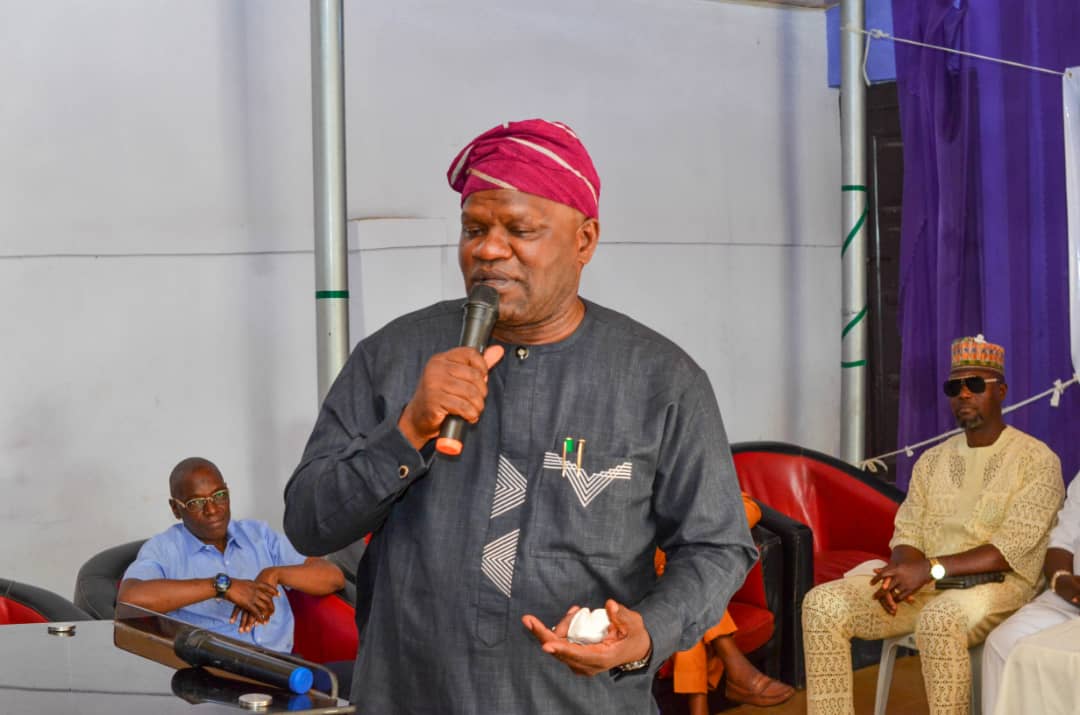
At Alegongo Community Hall in Akobo, Lagelu Local Government, the distribution symbolised more than welfare. Addressing beneficiaries, Adeaga reflected on the year’s progress, expressing gratitude to Governor Seyi Makinde for providing the resources that enabled micro-projects in 144 communities.
These interventions spanned potable water supply, erosion control, educational support and community healthcare centres, reinforcing the administration’s commitment to inclusive development.
Equally significant was the emphasis on continuity. Residents were urged to safeguard the projects within their domains, ensuring that the benefits extended beyond the present moment.
As welfare packages were distributed in Ibadan, similar exercises were taking place concurrently in Oke-Ogun, Oyo, Ibarapa and Ogbomoso, underscoring a statewide approach that left no region behind.
The voices of beneficiaries offered a compelling reflection on the year’s impact. Speaking on behalf of recipients in Ibadan, Pa Hamzat Ade praised the State Government for embedding care for the aged, widows and persons with disabilities into the practice of governance.
His words carried both gratitude and resolve, affirming the community’s commitment to supporting an administration that had demonstrated attentiveness to its most vulnerable citizens.
The presence of political leaders, local government officials and party stakeholders at these engagements further illustrated the collaborative ethos that underpinned Oyo State’s progress in 2025. It was a year defined not by spectacle, but by steady cooperation and mutual accountability.
As Oyo State steps beyond 2025, the lesson it offers is both simple and profound: development cannot be sustained by decree alone.
It flourishes when communities are empowered to lead, when governance listens as much as it directs, and when progress is measured by its endurance in everyday life.
In clean water that continues to flow, schools that remain centres of learning, and citizens who feel seen and valued, the State’s quiet revolution has left a legacy that speaks for itself.